
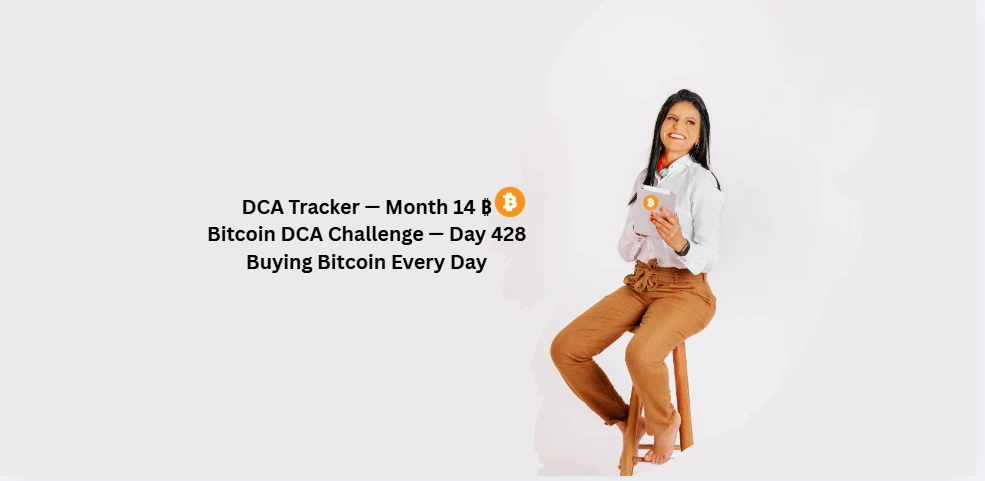
For 428 consecutive days, the discipline remained the same: buy Bitcoin. Not occasionally, not when the market feels comfortable, and certainly not when headlines turn optimistic. Simply buy — every day — regardless of price fluctuations.
This journey began with a simple engineering mindset: systems outperform emotions. Markets move in cycles, narratives shift, and volatility creates noise, but a disciplined structure continues to operate quietly in the background. The DCA Bitcoin Challenge was never designed as a short-term speculation experiment. It was designed as a long-term accumulation engine.
Today, after 428 days of continuous purchases, the strategy reveals something important about young financial systems. Crypto markets are still evolving. Infrastructure is still forming. Concepts like on-chain finance, decentralized liquidity, and synthetic yield mechanisms are still being understood by the broader public. Because of that, price asymmetry and volatility are not anomalies — they are natural characteristics of an emerging financial ecosystem.
This is where patience becomes a strategic advantage.
Rather than trying to predict every move in Bitcoin’s price, the approach focuses on building exposure gradually. Each purchase is small, but together they form a growing structural position. In engineering terms, this is not about chasing the highest stress point of the system. It is about building a resilient framework that survives stress cycles.
And cycles will come.
Markets rise, markets fall, narratives shift, and volatility returns again and again. But discipline — when applied consistently — turns time into an ally. Over months and years, the accumulation process continues quietly, even when the broader market appears chaotic.
This is the essence of the challenge: engineered patience.
📦 Related Reading — The First 365 Days
If you want to understand how this strategy evolved during its first full year, the previous report explains the structure and early lessons from the challenge.
➡️ https://damadefi.com/compras-diarias-de-bitcoin-o-que-mudou-apos-365-dias/
The Reality of an On-Chain Journey
One of the most interesting aspects of this journey is that it is being documented publicly.
There are no hidden entries, no selective reporting, and no retrospective editing of trades. Every step of the challenge has been shared as it happens — including moments when the market moved against the position.
Currently, the portfolio shows a negative mark-to-market result due to the broader Bitcoin correction. For many investors, this would be interpreted as failure.
But that interpretation misunderstands the nature of the strategy.
Young financial systems often go through periods of intense asymmetry. Prices may move faster than fundamentals. Narratives may change quickly. Liquidity can appear and disappear rapidly. These characteristics are common in emerging technologies.
The internet went through similar cycles during its early decades.
Bitcoin is no different.
Volatility is not a defect of the system — it is a reflection of a market that is still discovering its long-term equilibrium.
Women On-Chain: Walking the Path Alone
Another dimension of this journey deserves attention.
Building a financial strategy publicly as a woman in a technology-driven space is not always easy. The crypto ecosystem is still heavily dominated by technical communities and trading culture.
But that reality also creates opportunity.
Women entering the on-chain world bring a different perspective — often more focused on discipline, long-term planning, and risk awareness rather than aggressive speculation.
Walking this path sometimes means learning independently. It means studying, testing ideas, making mistakes, and refining systems without relying on ready-made templates.
In many ways, the journey resembles engineering research.
You observe systems.
You test hypotheses.
You document outcomes.
And gradually, you build understanding.
The Dama DeFi journey is not just about Bitcoin accumulation. It is also about showing that participation in on-chain finance does not require fitting into traditional market stereotypes.
It requires curiosity, discipline, and resilience.
Strategy Setup — DCA + Options Engine
Below is the consolidated setup of the strategy after 428 days
Strategy Setup — DCA + Options Engine
| Item | Value | Strategic Notes |
|---|---|---|
| Start date | 05 Jan 2025 | Beginning of the challenge |
| Days executed | 428 days | Continuous purchases |
| Capital invested (DCA) | $6,993 | Total capital deployed |
| BTC accumulated | 0.0586 BTC | Total BTC position |
| Average buy price | $98,997 | Impacted by market cycles |
| Average daily purchase | $13.37 | Sustainable allocation |
| Average monthly purchase | ~$401 | Long-term discipline |
| Current portfolio value | ~$5,560 | BTC + USDT |
| BTC position value | ~$3,944 | Mark-to-market BTC |
| Stablecoin liquidity | ~$1,615 USDT | Options premium reserve |
| Portfolio allocation | ~71% BTC / 29% USDT | Strategic liquidity |
| Options income generated | ~$1,615 | Synthetic dividends |
This structure creates a two-layer system.
Layer 1: Bitcoin accumulation through daily purchases.
Layer 2: Income generation through Bitcoin options premiums.
Together, they form a hybrid strategy designed to expand exposure over time while generating occasional stablecoin income.
Portfolio Overview — Asymmetry, Drawdown and Bitcoin Accumulation
After 428 days of continuous Bitcoin accumulation, the portfolio presents an interesting picture that is common in young and volatile markets.
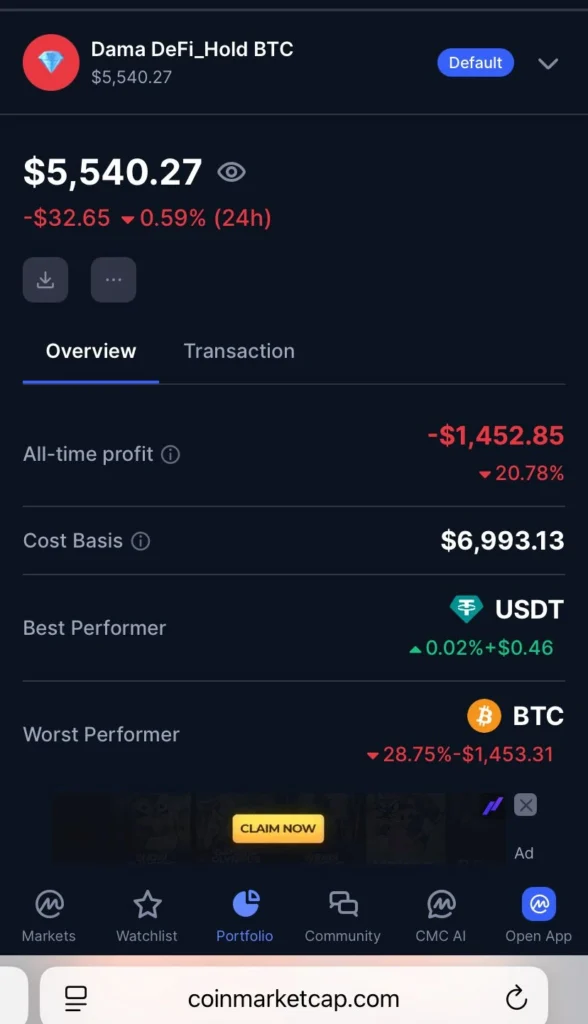
At the time of this report, the portfolio value stands at approximately $5,540, with a total cost basis of roughly $6,993. This results in a temporary unrealized drawdown of about $1,452, equivalent to approximately −20.7%.
At first glance, this may appear discouraging to investors who evaluate performance purely through short-term portfolio value. However, this perspective ignores one of the most important characteristics of emerging asset classes: market asymmetry.
Bitcoin remains part of a financial ecosystem that is still developing. Infrastructure, liquidity layers, and global adoption continue to evolve. In such environments, price movements rarely follow smooth trajectories. Instead, they occur in waves of rapid expansion followed by periods of correction and consolidation.
These drawdowns are not necessarily signs of structural weakness. In many cases, they represent the natural rhythm of a market that is still discovering its long-term equilibrium.
From an accumulation perspective, this asymmetry actually creates opportunity.
When prices decline during a DCA strategy, each purchase acquires more satoshis for the same capital allocation. Over time, these lower entries reduce the average acquisition cost and increase the total Bitcoin position.
In other words, volatility becomes a mechanism that accelerates accumulation.
This is particularly important in long-term strategies designed around consistent daily purchases. The system does not depend on predicting market peaks or bottoms. Instead, it gradually builds exposure across multiple cycles.
What appears as a temporary loss in dollar terms may simultaneously represent a stronger structural position in Bitcoin units.
That distinction is crucial.
The goal of the strategy is not to optimize short-term portfolio valuation. The objective is to increase the total amount of Bitcoin held over time, while allowing the market to fluctuate around that growing base.
This perspective transforms drawdowns from psychological threats into expected phases of the process.
In a young market like Bitcoin, patience and structural discipline often matter more than perfect timing.
And after 428 days of uninterrupted accumulation, the system continues to operate exactly as designed.
📦 Dama Talk — Options Strategy Report
The options component of the strategy is detailed in the latest Dama Talk report.
➡️ https://damadefi.com/dama-talk-february-2026-options-trades/
The Engineering of Patience
Patience is often misunderstood in finance.
Many people imagine patience as inactivity — simply waiting while markets move. But in reality, patience can be structured. It can be engineered into a system.
Daily Bitcoin accumulation is one example of that.
Instead of relying on perfect timing, the strategy transforms time itself into the central mechanism of growth. Each day adds a small increment to the position. Over months and years, those increments accumulate.
This approach removes one of the most destructive behaviors in investing: emotional timing.
Markets can rise dramatically and fall sharply within short periods. But the accumulation engine continues operating regardless of those fluctuations.
In engineering terms, this is similar to a process that continues functioning under variable load conditions.
The system adapts — but it does not stop.
Options Engine — Synthetic Bitcoin Dividends
While the daily Bitcoin purchases represent the structural foundation of the strategy, a second mechanism operates quietly alongside the accumulation process: the options engine.
The purpose of this component is simple.
Generate stablecoin income without selling Bitcoin.
In traditional markets, investors often rely on dividend-paying stocks to produce cash flow. Bitcoin, however, does not distribute dividends. Yet financial derivatives allow investors to create a similar effect by harvesting volatility.
This is where Bitcoin options enter the system.
Instead of speculating on price direction, the strategy sells out-of-the-money Bitcoin call options against the portfolio’s BTC exposure. When these contracts are sold, the buyer pays a premium, typically settled in stablecoins such as USDT.
Those premiums function as synthetic Bitcoin dividends.
If the option expires worthless or is closed early after most of the premium has decayed, the seller keeps the income while still maintaining the Bitcoin position.
In other words, the Bitcoin remains in the portfolio, while volatility itself becomes a source of yield.
Closed Bitcoin Options Trades — February Cycle
During the most recent cycle, several call options were opened and later closed after capturing the majority of the premium through time decay.
| Contract | Strike | Entry Premium | Exit Premium | ROI |
|---|---|---|---|---|
| BTC-27MAR26-104000-C | 104,000 | 480 | 105 | 78.13% |
| BTC-27MAR26-110000-C | 110,000 | 269 | 75 | 72.08% |
| BTC-24APR26-100000-C | 100,000 | 1,755 | 370 | 78.92% |
These trades followed a consistent operational rule: positions are typically closed after capturing 75–80% of the option premium.
This rule is important for risk management. Once most of the premium has been captured, the remaining value becomes relatively small compared to the risk of sudden price movements. Closing early protects the majority of the income while freeing capital for new opportunities.
In this cycle, the rule proved effective. Shortly after the trades were closed, the broader Bitcoin market experienced additional downward pressure.
Because the positions had already captured most of the premium, the strategy avoided unnecessary exposure to late-cycle volatility.

Total Premium Captured
Across the closed positions, the strategy generated approximately:
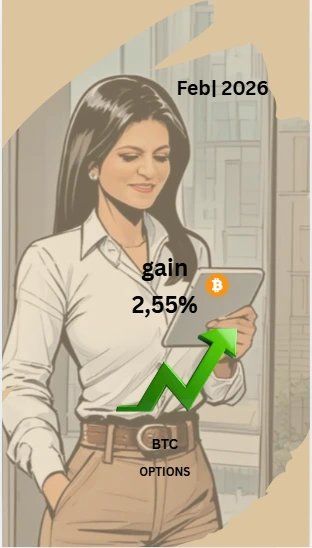
≈ 141.9 USDT in options premiums
With a portfolio value of roughly $5,540, this income represents a monthly yield of approximately:
≈ 2.55%
This is particularly interesting given the market context. Bitcoin itself experienced a price correction during the same period, producing a temporary mark-to-market loss in the portfolio.
Yet the options engine continued generating income.
This demonstrates one of the key advantages of combining accumulation with derivatives: volatility becomes productive rather than purely destructive.
📦 Dama Talk — Full Options Report
The detailed breakdown of the options strategy, including trade structure and premium capture logic, is available in the latest Dama Talk report.
➡️ https://damadefi.com/dama-talk-february-2026-options-trades/
Why This Matters for the Accumulation Strategy
The options component does not replace the Bitcoin accumulation engine. Instead, it complements it.
The structure operates like a dual-layer system:
Layer 1 — Bitcoin DCA
Daily purchases gradually increase the BTC position over time.
Layer 2 — Options Premiums
Selling volatility generates stablecoin income during market cycles.
This combination creates a powerful dynamic. Even during periods when Bitcoin’s price temporarily declines, the options strategy can continue generating cash flow.
Those stablecoins may later be reinvested into additional Bitcoin purchases, effectively expanding the accumulation engine.
Over long time horizons, this interaction between accumulation and income generation can significantly strengthen the overall strategy.
The Role of Volatility
Bitcoin remains one of the most volatile macro assets in the global financial system.
For many investors, volatility is a source of fear. Prices move rapidly, corrections can be sharp, and sentiment shifts quickly.
But for options sellers, volatility is also a source of opportunity.
Higher volatility increases option premiums, which means more income can be captured when selling contracts.
In this framework, market turbulence becomes something different.
Instead of trying to predict every price movement, the strategy focuses on harvesting volatility while continuing to accumulate the underlying asset.
Engineering Income Without Selling Bitcoin
From an engineering perspective, this structure behaves like a system with two independent inputs.
The first input is time — expressed through daily accumulation.
The second input is volatility — expressed through options premiums.
When both operate simultaneously, the result is a portfolio that grows through two mechanisms rather than one.
Bitcoin remains the core reserve asset.
But volatility itself becomes productive.
And in a young financial ecosystem like crypto, where volatility is abundant, that can become a powerful structural advantage.
Why Market Asymmetry Is Normal
Crypto markets often experience dramatic swings because they are still in a phase of structural discovery.
New financial instruments are emerging:
- On-chain liquidity pools
- Stablecoin settlement systems
- Bitcoin options markets
- DeFi lending structures
Each innovation introduces new behaviors and new participants into the system.
As a result, price dynamics can appear chaotic in the short term.
But chaos in emerging systems often precedes stabilization.
In the long run, markets gradually integrate these innovations and move toward equilibrium.
Understanding this process helps investors maintain perspective during volatile periods.
Conclusion
After 428 days, the challenge continues to demonstrate something simple but powerful.
Accumulation does not require perfect predictions.
It requires structure.
It requires patience.
And above all, it requires consistency.
In a market that is still discovering its long-term structure, the most reliable advantage may simply be the ability to remain present through the cycles.
That is the real challenge.
Not predicting Bitcoin.
But continuing to accumulate it.
FAQ — Bitcoin Daily Accumulation Strategy
1. Why buy Bitcoin every day instead of timing the market?
Daily accumulation removes the psychological burden of trying to predict short-term price movements. Timing the market consistently is extremely difficult, even for professional traders. By purchasing Bitcoin regularly, the strategy spreads entry points across many price levels, reducing the risk of making a large purchase at an unfavorable moment.
2. What is the purpose of the 3666-day Bitcoin challenge?
The challenge represents a long-term commitment to accumulation. Rather than focusing on short-term speculation, the goal is to gradually build a Bitcoin position over nearly a decade, allowing time and discipline to work together.
3. Why is patience important in crypto markets?
Crypto markets are still young and volatile. Prices can move dramatically within short periods due to new technology developments, regulatory changes, or shifts in investor sentiment. Patience allows investors to navigate these cycles without making emotional decisions.
4. Does the strategy require large amounts of capital?
No. One of the advantages of DCA is that it works with small, consistent contributions. Over time, even modest daily purchases can accumulate into a meaningful position.
5. Why combine Bitcoin DCA with options strategies?
Options strategies can generate premium income while maintaining Bitcoin exposure. This creates an additional income layer that can potentially support further accumulation.
6. What are synthetic Bitcoin dividends?
Synthetic dividends are option premiums received from selling Bitcoin options. These premiums function similarly to dividend income, even though Bitcoin itself does not pay dividends.
7. Is the current portfolio loss a failure of the strategy?
Not necessarily. Mark-to-market losses simply reflect current market prices. Long-term accumulation strategies often experience temporary drawdowns during market corrections.
8. Why keep USDT alongside Bitcoin in the portfolio?
Stablecoins provide liquidity. They allow the investor to manage positions, close trades, or deploy new strategies without selling Bitcoin.
9. How does volatility affect the strategy?
Volatility increases the value of options premiums, which can benefit option sellers. While price fluctuations may reduce portfolio value temporarily, they can also increase income opportunities.
10. What is the biggest challenge in long-term investing?
Emotional discipline. Many investors abandon strategies during periods of uncertainty or fear.
11. How does engineering thinking influence this strategy?
Engineering focuses on system design and resilience. Instead of reacting to every market movement, the strategy relies on a structured framework that continues operating through different conditions.
12. Why is documenting the journey publicly important?
Public documentation increases transparency and accountability. It allows others to observe the strategy as it evolves over time.
13. What role do women play in the on-chain ecosystem?
Women are increasingly participating in decentralized finance and blockchain technology. Their perspectives often emphasize discipline, education, and long-term thinking.
14. Is Bitcoin still considered an emerging asset?
Yes. Although Bitcoin has existed for more than a decade, global adoption and financial integration are still in early stages.
15. Can long-term strategies outperform active trading?
Many studies suggest that disciplined long-term accumulation can outperform frequent trading due to reduced emotional decision-making.
16. Why are crypto markets considered asymmetric?
Because their potential upside is still being discovered while risks remain significant.
17. What happens if Bitcoin continues to fall?
The accumulation strategy continues purchasing at lower prices, reducing the average cost over time.
18. Why track average purchase price?
The average price provides insight into how effectively the strategy spreads risk across different market cycles.
19. Is the strategy suitable for everyone?
No strategy fits all investors. Individuals should consider their risk tolerance and financial situation.
20. What lessons have emerged after 428 days?
Consistency, patience, and structured thinking are more important than predicting short-term market movements.
21. What is the advantage of documenting long-term experiments?
It allows others to learn from real data rather than theoretical assumptions.
22. How does Bitcoin differ from traditional assets?
Bitcoin operates on a decentralized network with a fixed supply, unlike fiat currencies controlled by central banks.
23. Why is scarcity important in Bitcoin?
Bitcoin’s supply is capped at 21 million coins, which creates a unique economic structure.
24. What risks exist in crypto investing?
Price volatility, regulatory uncertainty, technological risks, and market speculation.
25. Why is diversification important even within crypto?
Diversification can reduce exposure to specific risks associated with individual assets or strategies.
26. What role does discipline play in investing?
Discipline ensures that strategies are followed consistently regardless of market emotions.
27. Can options strategies increase accumulation capacity?
Yes, if premiums are reinvested into Bitcoin purchases.
28. How long should a strategy like this run?
Ideally several years, allowing multiple market cycles to occur.
29. What is the most important factor for success in long-term accumulation?
Consistency.
30. What does the future of on-chain finance look like?
It will likely continue evolving as new financial instruments and decentralized infrastructures emerge.