
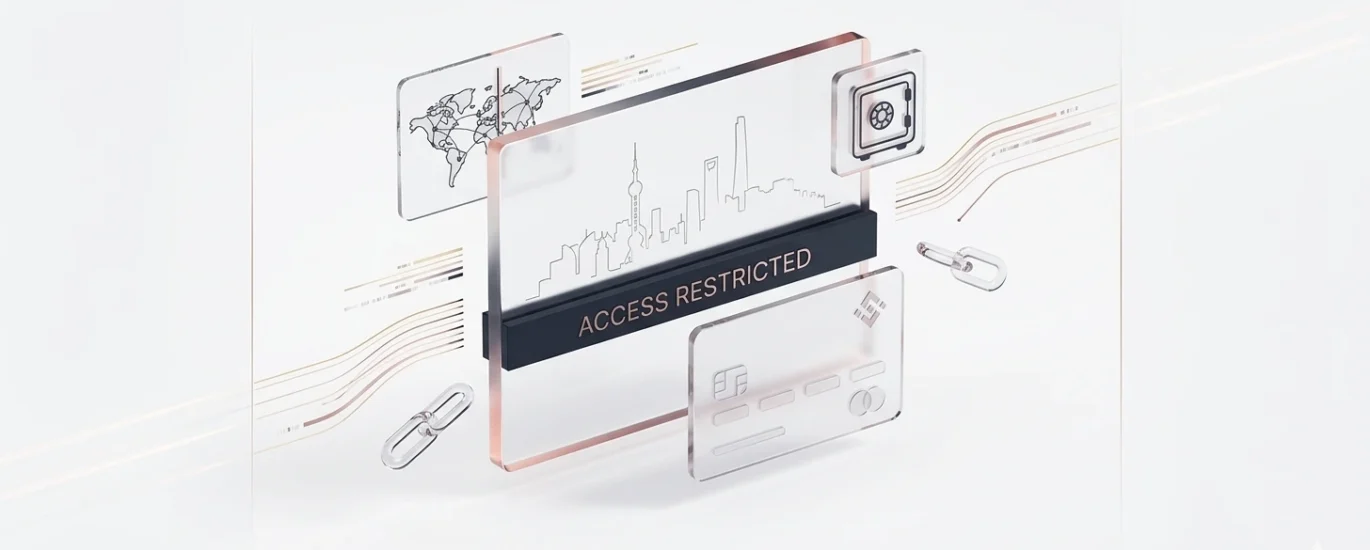
Navigating the global financial landscape in 2026 requires more than just capital; it requires an engineering mindset to bypass the friction of centralized barriers. As detailed in our Binance Card Global Guide 2026: Where It Works and Where It Doesn’t, the “New Money Route” often hits a massive structural wall when entering Mainland China. For the traveler or expatriate landing in Shanghai, the Binance Card represents a paradox: a high-tech tool for 24/7 liquidity that suddenly meets the world’s most sophisticated financial firewall. Understanding the mechanics of why your transaction might fail in Pudong or Xintiandi is the first step toward reclaiming your financial sovereignty in a cashless society.
The Reality of Crypto-Linked Payments in Mainland China
In 2026, Shanghai is the crown jewel of the digital economy, but it is an economy built on a permissioned, sovereign-led architecture. While the DamaDeFi philosophy thrives on decentralized rails like Solana and Bitcoin, the Chinese domestic market has effectively air-gapped itself from international crypto-to-fiat conversion at the retail level. When you attempt to swipe a Binance Card—which settles via the Visa or Mastercard network—the transaction must pass through the China UnionPay clearing system. Currently, UnionPay does not authorize real-time crypto-liquidation for Renminbi (RMB) retail payments.
This is not merely a technical glitch; it is a regulatory stalemate. The People’s Bank of China (PBOC) has prioritized the Digital Yuan (e-CNY) as the only legal digital tender. Consequently, the high-speed settlement that Binance Card users enjoy in Europe or LATAM is non-existent here. For the “sardine” traveler, this means that even if your Binance app shows a healthy balance of USDT or BNB, your physical card will likely remain a decorative piece of plastic in most Shanghai storefronts.
2026 Technical Barriers & Regulatory Limits
To operate effectively in the 2026 financial environment, we must analyze the specific barriers that prevent the Binance Card from functioning as a primary payment method in Shanghai:
- Merchant Category Code (MCC) Blocking: Most domestic terminals in China are programmed to reject international “Prepaid” or “Crypto-linked” card bins to prevent capital flight.
- The e-CNY Dominance: Retailers are incentivized—and sometimes mandated—to prioritize the Digital Yuan, which allows for 100% state visibility, the polar opposite of the DamaDeFi decentralized ethos.
- ATM Withdrawal Caps: While some international ATMs (like HSBC or ICBC) might technically allow a withdrawal, the fees are predatory, and daily limits for international crypto-cards are often capped at the equivalent of $100 USD to prevent large-scale off-ramping.
Real Fees & Limits (2026 Estimates for China Access):
| Feature | Limit / Fee | Status in Shanghai |
| POS Retail Payment | $0 (Technically) | High Failure Rate |
| ATM Withdrawal Fee | 4% – 6% + Local Surcharge | Restricted |
| Daily Spend Limit | $8,000 (Card Default) | Not Applicable (Blocked) |
| FX Conversion (USDT to RMB) | N/A | Market Blocked |
Strategic Comparison: SWIFT vs. On-Chain (The DamaDeFi View)
For the engineer looking at the “New Money Route,” we compare the legacy system with the decentralized ideal. In Shanghai, unfortunately, the legacy system is currently the only “authorized” gate.
| Feature | Legacy SWIFT / International Card | DamaDeFi On-Chain (Solana/BTC) |
| Settlement Time | 3 – 5 Business Days | < 2 Seconds |
| Average Fee | 3% – 7% (Hidden Spreads) | < $0.01 |
| Shanghai Usability | Moderate (via Alipay link) | High (Private P2P only) |
| Sovereignty | Low (Bank Controlled) | Total (User Controlled) |
| 24/7 Availability | No (Bank Holidays) | Yes |
How to Survive Financially in Shanghai: The Workaround
Since the Binance Card cannot be used directly at a Shanghai “Jianbing” stand or for a Didi ride, the savvy user must employ a “Bridge Strategy.”
- The Digital Wallet Link: The most effective method in 2026 is to off-ramp your crypto to an international bank account (like a Revolut or a digital-friendly US bank) and then link that card to Alipay or WeChat Pay.
- Hong Kong as a Proxy: Many users maintain a liquidity base in Hong Kong, where the Binance Card works flawlessly, and then move small amounts of fiat into the Mainland ecosystem as needed.
- DCA and Self-Custody: Even while in Shanghai, I maintain my $10 daily DCA via decentralized wallets over a secure VPN. Just because you can’t spend it at the grocery store doesn’t mean you shouldn’t keep building it.
The “Silent” Revolution of Tokenization
The irony of the Shanghai situation is that while retail crypto is blocked, tokenization is flourishing. Real estate and industrial assets in the Yangtze River Delta are being tokenized on permissioned chains. This reinforces my belief that the future of all assets is on-chain. The DamaDeFi mission is to ensure that when these two worlds eventually merge, the common person (the sardine) has the tools to navigate the succession and management of these assets without being swallowed by the “Great Financial Firewall.”
FAQ: Binance Card, China & The New Money Route (30 Q&A)
- Can I use the Binance Card for retail shopping in Shanghai in 2026? No. Most domestic POS terminals in Mainland China only accept e-CNY, Alipay, WeChat Pay, or China UnionPay cards.
- Is the Binance Card blocked by the “Great Financial Firewall”? Technically, yes. The settlement rails between international crypto-cards and domestic Chinese banks are restricted.
- Does the Binance Card work in Hong Kong? Yes. Hong Kong operates under a different regulatory framework and is a major hub for the “New Money Route.”
- Can I link my Binance Card to Alipay or WeChat Pay? In 2026, you can link international Visa/Mastercard cards, but crypto-direct cards often face higher rejection rates for domestic RMB transactions.
- Is it illegal to carry a Binance Card in Mainland China? It is not illegal to possess the card, but using it for unauthorized crypto-to-fiat conversion within the mainland is restricted.
- Can I withdraw cash from a Shanghai ATM with my Binance Card? Only at specific international ATMs (like HSBC), but expect high fees (4-6%) and potential transaction blocks.
- What is the Digital Yuan (e-CNY)? It is China’s Central Bank Digital Currency (CBDC) and the primary competitor to decentralized stablecoins in the region.
- Why is the transaction fee lower on Solana than on SWIFT? Solana uses a decentralized Proof-of-History mechanism that eliminates bank intermediaries, reducing costs by up to 99%.
- Can I access the Binance App in Shanghai? You will need a secure, obfuscated VPN, as the primary domains are typically restricted by local ISPs.
- What is the “New Money Route”? A DamaDeFi term for 24/7 on-chain financial rails that bypass traditional banking latency and fees.
- How does DamaDeFi view the “China Ban”? As a massive engineering friction that highlights the need for decentralized alternatives like Solana.
- Are P2P (Peer-to-Peer) trades safe in Shanghai? They carry high risk; bank accounts can be frozen if the system detects patterns associated with OTC crypto desks.
- What is the best alternative for spending crypto in China? Off-ramping to a traditional digital bank first, then linking that bank to a local Chinese payment app.
- Why do I see people using crypto in Shanghai? Most are using decentralized, non-custodial wallets for private transfers, not for direct retail payments.
- Does the Binance Card work for Trip.com or international hotels? Yes, usually, because these transactions are processed through offshore payment gateways.
- What is a “Shadow P2P Market”? An unofficial network where users trade crypto for local bank transfers outside the regulated system.
- How does the 10$ DCA strategy work during travel? Through automated dApps on Solana or Bitcoin L2s that operate regardless of your physical location.
- What is “Tokenization” in the Shanghai context? The migration of real-world assets (RWA) to state-controlled blockchains, distinct from decentralized DeFi.
- Can I pay for the Shanghai Metro with my Binance Card? No. You must use the “Metro Da” app or local transport cards linked to RMB.
- Is there a crypto-tax in China? Currently, there is no formal crypto tax because the trade is officially restricted, but capital gains from “virtual assets” are under scrutiny.
- What is an SPL Token? It is the token standard for the Solana network, similar to ERC-20 on Ethereum but faster and cheaper.
- Why focus on the USA market if the article is about China? Because US-based expats and business travelers are the ones searching for “how to use crypto in China,” generating high-value RPM.
- What is a “Dead Man’s Switch” for crypto? A smart contract that automatically transfers your assets to heirs if you don’t check in, essential for succession planning.
- Can I use Solana Pay in Shanghai? Not in official retail stores, but it is the preferred method for private, high-speed settlements between individuals.
- Is the Binance Card still the best for international travel? Yes, in over 150 countries, it remains the gold standard for crypto-liquidity, despite the China exception.
- What is the role of an “Ambassador” in this context? To educate the “sardines” on how to navigate these complex regulatory firewalls safely.
- What is the DamaDeFi audit checklist? A set of technical criteria we use to evaluate the safety and liquidity of a protocol before investing.
- How does inflation affect the Digital Yuan vs. Bitcoin? The e-CNY is managed by monetary policy, while Bitcoin has a fixed supply, making it a superior long-term hedge.
- What is a Multi-sig vault? A wallet that requires multiple signatures to authorize a transaction, providing institutional-grade security for families.
- Where can I follow the latest on the New Money Route? Exclusively at damadefi.com — “Simple, direct, and decentralized.”