
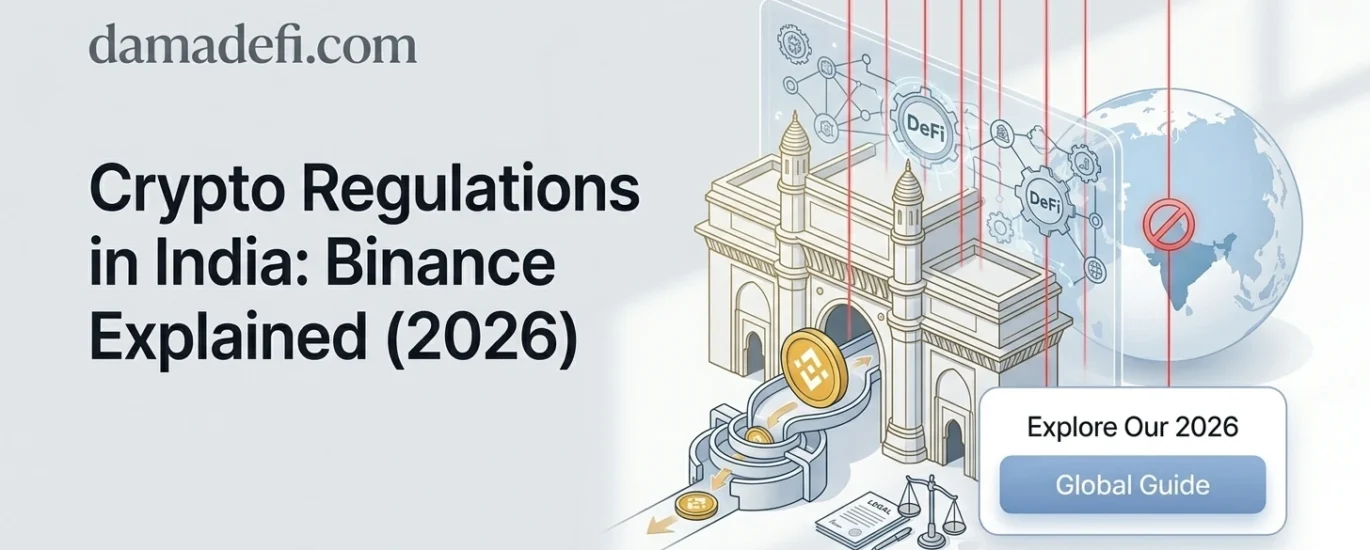
In the rapidly shifting sands of the global digital economy, India stands as one of the most significant yet complex markets for blockchain technology. If you are using Binance in the subcontinent in 2026, you aren’t just navigating an app; you are navigating a sophisticated legal fortress.
The relationship between Binance and Indian authorities has transformed from a period of “shadow operations” to a strictly regulated, FIU-registered reality. Understanding these rules is no longer optional for the modern investor—it is a survival skill.
In this guide, we break down the three pillars of Indian crypto regulation: compliance, taxation, and the operational boundaries that dictate what you can and cannot do with your Binance account.
1. The FIU-IND Registration: Binance’s Legal Passport
By 2026, Binance has successfully transitioned into a Registered Reporting Entity under India’s Financial Intelligence Unit (FIU-IND). After paying a landmark $2.25 million fine in 2024 to settle past non-compliance, the exchange now operates with the government’s watchful blessing.
What this means for you:
- Aadhaar-Linked e-KYC: Your identity is now cross-referenced with the national database.
- Liveness Detection: To prevent deepfakes, Binance now requires real-time facial movement verification during login and high-value withdrawals.
- Transaction Monitoring: Every trade is logged. The days of “anonymous” high-volume trading are officially over in the Indian corridor.
2. The “30-1” Taxation Formula
India’s tax framework for Virtual Digital Assets (VDAs) remains the strictest among major economies. As of 2026, the government maintains a dual-layer tax system that impacts every click on the Binance interface.
The 30% Flat Tax (Section 115BBH)
Any profit earned from the transfer of crypto is taxed at a flat rate of 30%.
Important: You cannot offset losses from one coin against gains from another. If you make $1,000 on Bitcoin but lose $1,000 on Solana, you still owe the government 30% on the Bitcoin profit.
The 1% TDS (Section 194S)
The “Tax Deducted at Source” is the primary reason why services like the Binance Card remain blocked. Every time you sell crypto or swap one token for another, 1% of the total transaction value is withheld and sent to the Income Tax Department.
3. P2P Trading and the Safety Net
Peer-to-Peer (P2P) trading remains the heartbeat of the Indian crypto community, but in 2026, the risks have changed. Since Binance is now FIU-compliant, it must report suspicious bank accounts involved in P2P.
To stay safe, Indian users must:
- Only trade with Verified Merchants.
- Ensure the bank account name matches the Binance KYC name.
- Avoid descriptions like “Crypto” or “Binance” in IMPS/UPI transfer remarks.
Summary Table: Binance Operations in India (2026)
| Feature | Status | Requirement / Note |
| Spot Trading | ✅ Active | 1% TDS applies to all sell/swap orders. |
| P2P Market | ✅ Active | High liquidity, but requires strict KYC matching. |
| Binance Card | ❌ Blocked | Due to real-time TDS and FEMA compliance issues. |
| Staking/Earn | ✅ Active | Rewards taxed at your income slab rate upon receipt. |
| Futures/Leverage | ⚠️ Restricted | Subject to high-risk warnings and specific tax reporting. |
4. Why Decentralization Still Matters
“Simple, direct, and decentralized.” This remains our mantra at DamaDeFi. While Binance provides the bridge, the regulatory environment in India reinforces the need for users to understand self-custody. Regulation brings safety and institutional money, but it also brings transparency that contradicts the original ethos of Bitcoin.
As a Binance user in India, you are participating in a regulated experiment. You have the world’s most powerful trading tools at your fingertips, but they come with a “tax-first” infrastructure that demands meticulous record-keeping.
💡 Related Insights
Binance Card Global Guide 2026: Where It Works and Where It Doesn’t
“Simple, direct, and decentralized.” [Access the Pillar Guide]

FAQ: India Crypto Regulations & Binance (30 Q&A)
- Is Binance legal in India now? Yes, as a registered FIU-IND reporting entity.
- Do I have to pay tax if I don’t withdraw to a bank? Yes, the 30% tax applies to “transfers” (including crypto-to-crypto swaps).
- Does Binance deduct the 30% tax automatically? No, you must calculate and pay this during your annual ITR filing.
- Does Binance deduct the 1% TDS? Yes, for most trading pairs involving INR or VDA transfers, the platform handles the deduction.
- Can I use Binance without KYC in India? No, KYC is mandatory for all features in 2026.
- What is the penalty for not reporting crypto? Penalties include a ₹200 per day fine for non-furnishing and up to ₹50,000 for inaccurate details.
- Is UPI supported for deposits? Directly, no. Usually via P2P merchants.
- Are NFTs taxed differently? No, NFTs are classified as VDAs and follow the same 30% tax rule.
- Can I offset my mining costs? Only the “cost of acquisition” is deductible. Electricity and hardware are not.
- What is Form 26QE? It is the statement filed for TDS deducted on crypto transactions.
- Can I use Binance.US in India? No, you must use the global Binance.com platform.
- Is my crypto insured by the Indian government? No, crypto assets have no sovereign guarantee.
- Can I gift crypto to a family member? Yes, but the receiver may be liable for tax on the gift’s value.
- Does the RBI ban crypto? No, the RBI does not ban it, but they strictly regulate bank interactions.
- What happens to my account if I travel abroad? Your KYC remains Indian, so Indian tax laws still apply to your account.
- Are stablecoins like USDT taxed? Yes, they are treated as VDAs.
- Can I pay for a VPN with crypto in India? Yes, but it’s considered a “transfer” and triggers the 1% TDS.
- Is Binance safer than Indian exchanges? It has higher liquidity and the SAFU fund, but Indian exchanges offer easier local tax reporting.
- What is the FIU-IND? The Financial Intelligence Unit of India, which tracks money laundering.
- Can I lose my bank account for trading crypto? Only if you engage in suspicious P2P activities that trigger an AML alert.
- Does Binance share data with the Income Tax Department? As a registered entity, they are required to provide data upon official request.
- What is the 4% Cess? A health and education tax added on top of your 30% crypto tax.
- Can I trade Futures in India? Yes, but profits are taxed at 30%.
- Are airdrops taxable? Yes, usually at the fair market value on the date of receipt.
- Is there a threshold for the 1% TDS? ₹50,000 per year for most individuals; ₹10,000 for others.
- Why is the Binance app back on the App Store? Because Binance complied with the FIU-IND registration requirements.
- Can I trade on Decentralized Exchanges (DEXs)? Yes, but you are still legally responsible for reporting those gains.
- Does Binance offer an Indian Rupee (INR) pair? Only via P2P or specific third-party ramps.
- Will the 30% tax ever decrease? Industry bodies are lobbying for it, but no change is confirmed for 2026.
- Where can I get help with my crypto taxes? Consult a CA specialized in VDAs or use software like KoinX or CoinTracker.