

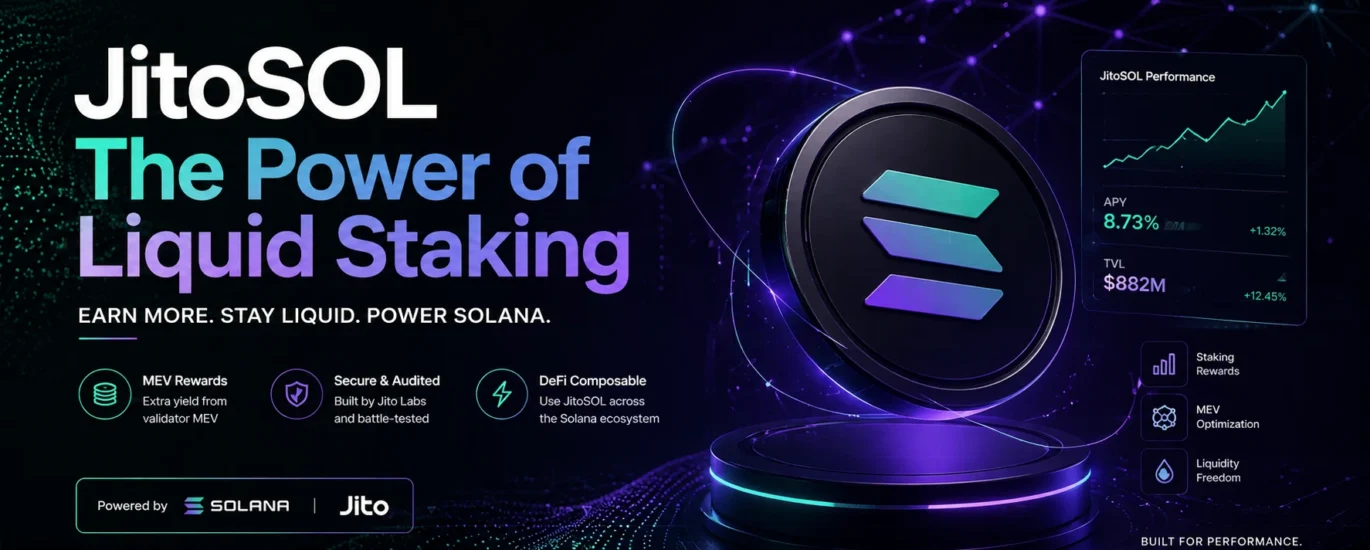
Insights
- Liquid staking unlocks capital efficiency: JitoSOL, mSOL, and bSOL allow you to earn staking rewards while staying liquid across DeFi.
- Yield is not equal: Differences in MEV capture (Jito), validator strategy (Marinade), and ecosystem integrations (Blaze) create real performance gaps.
- Risk is layered: Smart contracts, validator sets, and liquidity depth matter more than headline APY.
Solana Staking Rewards: Comparing JitoSOL, mSOL, and bSOL. We don’t approach staking as spectators. We deploy capital. We measure yield. We manage risk. This comparison between JitoSOL, mSOL, and bSOL comes from a skin in the game perspective—real positions, real trade-offs, and real consequences. In Solana, staking is no longer just about locking SOL. It’s about choosing the right liquid staking derivative (LSD) that aligns with your strategy across DeFi.
What Is Liquid Staking on Solana?
Traditional staking locks your SOL. Liquid staking changes that.
When you stake through a protocol, you receive a derivative token:
- Stake SOL → Receive JitoSOL / mSOL / bSOL
- These tokens represent your staked position + rewards
- You can use them across DeFi (LPs, lending, yield strategies)
Why Liquid Staking Matters
| Feature | Traditional Staking | Liquid Staking |
|---|---|---|
| Liquidity | ❌ Locked | ✅ Tradable |
| DeFi Integration | ❌ None | ✅ Full |
| Capital Efficiency | Low | High |
| Complexity | Low | Medium |
Overview of JitoSOL, mSOL, and bSOL
Each protocol has a different philosophy.
JitoSOL (Jito Labs)
- Focus: MEV (Maximal Extractable Value) rewards
- Adds extra yield from block optimization
- Strong integration with Solana validator ecosystem
mSOL (Marinade Finance)
- Focus: Decentralization
- Delegates across many validators
- One of the largest TVLs in Solana staking
bSOL (BlazeStake)
- Focus: Performance + simplicity
- Optimized validator selection
- Growing DeFi integrations
Yield Comparison: Where Returns Actually Come From
Yield is not just staking APR.
Yield Sources
| Source | JitoSOL | mSOL | bSOL |
|---|---|---|---|
| Base Staking Yield | ✅ | ✅ | ✅ |
| MEV Rewards | ✅ | ❌ | ❌ |
| Validator Optimization | Medium | High | High |
| DeFi Incentives | Medium | High | Medium |
Practical Insight
- JitoSOL → Higher upside due to MEV
- mSOL → Stable, diversified yield
- bSOL → Balanced performance
Fee Structures and Cost Efficiency
Fees directly impact net yield.
Fee Comparison Table
| Protocol | Management Fee | Hidden Costs | Net Efficiency |
|---|---|---|---|
| JitoSOL | ~5% rewards | Low | High |
| mSOL | ~6% rewards | Low | Medium-High |
| bSOL | ~5% rewards | Low | High |
Key Takeaway
Small differences in fees compound significantly over time.
Risk Analysis: What Most People Ignore
Liquid staking is not risk-free.
1. Smart Contract Risk
| Protocol | Audit Status |
|---|---|
| JitoSOL | Audited |
| mSOL | Audited |
| bSOL | Audited |
All are audited—but audits ≠ zero risk.
2. Validator Risk
- Poor validator performance reduces yield
- Centralization increases systemic risk
3. Depeg Risk
LST tokens can trade below SOL in extreme conditions.
TVL and Market Position
TVL is a proxy for trust and liquidity.
TVL Comparison (Relative)
| Protocol | TVL Strength | Liquidity Depth |
|---|---|---|
| mSOL | Very High | Strong |
| JitoSOL | High | Growing |
| bSOL | Medium | Moderate |
Interpretation
- mSOL = most battle-tested
- JitoSOL = fastest-growing narrative
- bSOL = niche but efficient
Usability and DeFi Integration
Where You Can Use These Tokens
| Use Case | JitoSOL | mSOL | bSOL |
|---|---|---|---|
| Liquidity Pools | ✅ | ✅ | ✅ |
| Lending | ✅ | ✅ | ✅ |
| Collateral | Growing | Strong | Growing |
UX Differences
- mSOL: Widest integration
- JitoSOL: Rapid expansion
- bSOL: Simpler but smaller ecosystem
Strategy Layer: How to Allocate Capital
This is where decisions matter.
Conservative Strategy
- 60% mSOL
- 30% JitoSOL
- 10% bSOL
Balanced Strategy
- 40% mSOL
- 40% JitoSOL
- 20% bSOL
Aggressive Strategy
- 50% JitoSOL
- 30% bSOL
- 20% mSOL
Advanced Insight: MEV Is the Differentiator
JitoSOL introduces something unique:
Additional yield from MEV extraction.
This creates:
- Higher upside
- More complexity
- Dependence on validator behavior
Real-World Execution Considerations
From actual usage:
- mSOL is the easiest to deploy across DeFi
- JitoSOL offers better yield during high activity
- bSOL performs well in stable conditions
Security Best Practices
- Use hardware wallets
- Avoid unknown integrations
- Track validator performance indirectly via protocol updates
Conclusion: Which One Should You Choose?
There is no single winner.
- mSOL: Best for stability and integration
- JitoSOL: Best for yield optimization
- bSOL: Best for simplicity and efficiency
The real edge is diversification.
Liquid staking is not just about earning yield—it’s about deploying capital intelligently across a composable ecosystem.
JitoSOL as Financial Engineering — Yield, MEV and On-Chain Capital Flow
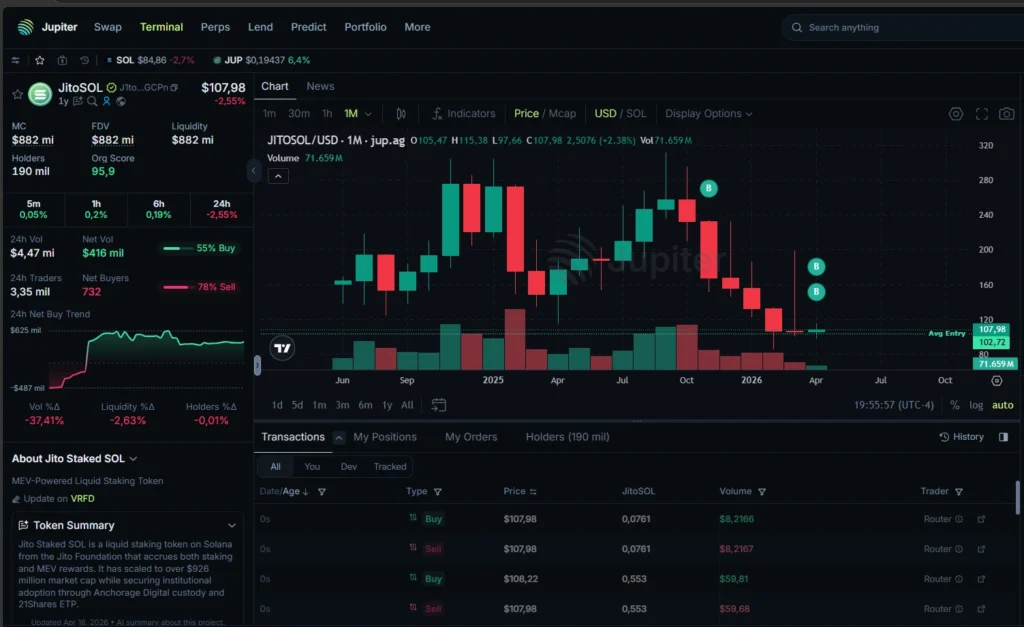
The image above shows the JitoSOL market on Jupiter Terminal, but what you are really looking at is not just a price chart.
You are looking at a financial instrument engineered on top of Solana staking.
🧠 What JitoSOL Actually Is (Beyond the Token)
JitoSOL is not “just a liquid staking token”.
It is a yield-optimized derivative, composed of:
- Base SOL staking rewards
- MEV (Maximal Extractable Value) capture
- Validator-level optimization
- Liquidity layer via DeFi
📌 From a Financial Engineering Perspective
JitoSOL can be modeled as:
JitoSOL = Staked SOL + MEV Yield + Liquidity Premium
📈 Reading the Image Like an Operator
From the Jupiter interface:
- Price: ~$107.98
- FDV / MC: ~$882M
- Liquidity: ~$882M
- 24h Volume: ~$4.47M
- Net Flow: Negative bias (more sellers than buyers)
What This Means
This is not just price action.
It reveals:
- Institutional-level liquidity
- Active trading of a yield-bearing asset
- Continuous price discovery
⚙️ How JitoSOL Works Under the Hood
Step-by-Step Flow
- You stake SOL via Jito
- Validators process transactions
- MEV opportunities are extracted
- Rewards are distributed
- You receive JitoSOL
- JitoSOL appreciates relative to SOL
💡 The MEV Layer (The Real Differentiator)
Most liquid staking tokens only generate:
- Base staking yield (~6–8%)
JitoSOL adds:
- MEV rewards (extra yield layer)
Types of MEV Captured
- Arbitrage between DEXs
- Liquidation opportunities
- Transaction ordering optimization
📊 Yield Composition Breakdown
| Yield Source | Contribution |
|---|---|
| Staking Rewards | Base layer |
| MEV Rewards | Alpha layer |
| DeFi Usage | Optional layer |
⚠️ Risk Analysis Through Engineering Lens
JitoSOL introduces additional complexity.
1. Validator Dependence
- MEV depends on validator performance
- Misalignment reduces yield
2. Smart Contract Layer
- Liquid staking protocol risk
- Integration risk across DeFi
3. Market Liquidity Risk
From the image:
- Strong liquidity → good exit conditions
- But volatility still exists
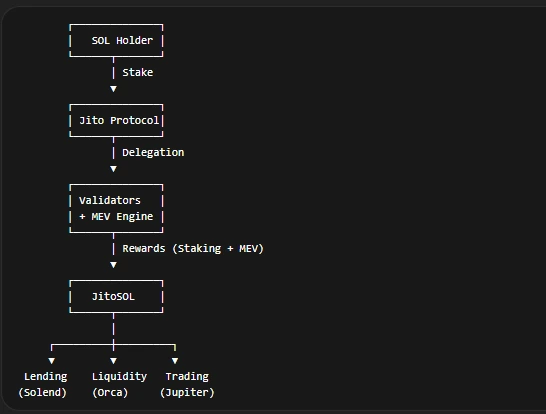
🔄 Capital Flow in the Jito Ecosystem
This is where it becomes powerful.
JitoSOL is not static.
It moves across:
- Lending protocols
- Liquidity pools
- Trading platforms (like Jupiter)
Conceptual Figure — JitoSOL Financial System
Here is a simplified model:
People Also Ask (FAQ)
- What is liquid staking on Solana?
Liquid staking allows you to stake SOL and receive a derivative token (like mSOL, JitoSOL, or bSOL) that continues earning rewards while being usable in DeFi.
👉 To understand how this fits into the broader ecosystem, read: https://damadefi.com/solana-ecosystem-guide-2026/
- What is JitoSOL and how does it generate extra yield?
JitoSOL includes MEV (Maximal Extractable Value) rewards, meaning validators extract additional value from transaction ordering, increasing yield beyond base staking.
- What is mSOL and why is it considered more decentralized?
mSOL distributes stake across a large set of validators, reducing centralization risk and improving network resilience.
- What is bSOL and how is it different?
bSOL focuses on optimized validator selection and simplicity, offering competitive yields with a leaner ecosystem footprint.
- Which liquid staking token has the highest yield?
JitoSOL often leads due to MEV rewards, but yield fluctuates depending on network activity and validator performance.
- Is liquid staking better than traditional staking?
Yes, because it unlocks liquidity and allows capital to be used in other DeFi strategies simultaneously.
- Can I use mSOL, JitoSOL, or bSOL in lending protocols?
Yes, these tokens can be used as collateral in platforms like Solend and MarginFi.
👉 Compare lending safety here: https://damadefi.com/solend-vs-marginfi-which-is-the-safest-lending/
- What is the biggest risk of liquid staking?
The main risks are smart contract vulnerabilities, validator underperformance, and potential depeg events.
- What is a depeg and why does it matter?
A depeg happens when a liquid staking token trades below the value of SOL, often during market stress or liquidity issues.
- Are staking rewards guaranteed?
No. Rewards depend on validator performance, network conditions, and protocol efficiency.
- How liquid are these staking tokens?
mSOL has the deepest liquidity, followed by JitoSOL, while bSOL has less liquidity but is growing.
- Can I lose money with liquid staking?
Yes, especially if you sell during a depeg or use the tokens in risky DeFi strategies.
- What is the role of TVL in staking protocols?
TVL (Total Value Locked) indicates trust and adoption—higher TVL usually means better liquidity and stability.
- Which protocol is safest: Jito, Marinade, or Blaze?
All are audited, but Marinade (mSOL) is generally seen as more decentralized, while Jito introduces additional complexity with MEV.
- How does liquid staking connect with the Solana ecosystem?
It acts as a base layer for DeFi, enabling lending, liquidity pools, and leveraged strategies.
👉 Full ecosystem breakdown: https://damadefi.com/solana-ecosystem-guide-2026/
- Can I combine staking with liquidity pools?
Yes, you can provide liquidity using staking derivatives, but this adds impermanent loss risk.
- Is liquid staking passive income?
Not fully. While rewards are automatic, managing positions in DeFi requires active monitoring.
- What is the best strategy for beginners?
Start with mSOL for stability, then gradually explore JitoSOL for higher yield opportunities.
- How do I choose between Solend and MarginFi for using these tokens?
It depends on risk tolerance, collateral factors, and protocol security.
👉 Detailed comparison: https://damadefi.com/solend-vs-marginfi-which-is-the-safest-lending/
- What is the smartest way to use liquid staking in DeFi?
The smartest approach is diversification:
- Stake SOL → Receive LST
- Use part in lending
- Use part in LPs
- Keep part liquid for flexibility
👉 Master the full strategy here: https://damadefi.com/solana-ecosystem-guide-2026/






If you’re considering to hire moto de agua Tenerife or seeking for rental options around the location, there are numerous of options to look into, especially in Tenerife Sur and Los Gigantes. Rates tend to shift depending on the spot and period, so it’s a wise idea to explore multiple companies before deciding. For those interested in a bit more adventure, there are also numerous of jet ski tours and safaris accessible, such as the top-rated jet ski safari Tenerife or activities in Golf Sur.
To find the most complete overview of options for jet ski hire and alquiler motos acuaticas Tenerife, I found this site genuinely helpful jet ski los gigantes . Regardless of whether you fancy a easy ride along Costa Adeje or a trip more thrilling around Playa de las Americas, the variety of jet ski hire options and outings makes it effortless to find something that meets your background and means.
When you have blonde hair, bright eyes, and light complexion, deciding on the most flattering clothing shades can greatly boost your overall look. Soft summer hair colors like saturated summer tones or cool winter hair colors regularly enhance pale skin beautifully, delivering a unified and radiant look. It’s beneficial to exploring soft summer hair colour ideas and color palettes to find the optimal hair colour for a summer colour palette that works with your complexion.
For individuals seeking to understand which shades flatter light skin tones with blonde hair, hair color analysis can be a valuable guide. The optimal shades for fair skin with blonde hair commonly involve crisp cool shades, which match seamlessly with ideal cool summer shades, achieving a stunning and radiant result. Review further guidance and suggestions here best clothing colors for blonde hair blue eyes fair skin when seeking tailored recommendations.
Si vas buscas experiencias acuaticas en la zona de Puerto Colon Tenerife, reservar motos de agua es una maravillosa posibilidad para descubrir la orilla y disfrutar del litoral de estilo divertida y emocionante. En la parte sur de la isla, particularmente en destinos como Los Gigantes o Costa Adeje, dispondras de desde alquileres basicos hasta recorridos en moto de agua que se adaptan a todos los niveles y presupuestos.
Para quien buscan comparar tarifas y alternativas, te animo a consultar tarifas de empresas que proporcionan excursiones y alquiler en jetskis en Tenerife, ofreciendo tambien propuestas como safari acuatico o alquiler de motos de agua en Santa Cruz de Tenerife. Mas informacion y referencias sobre precios y rutas encontraras aqui: alquiler motos acuaticas tenerife . ?Genial para disfrutar de un dia unico y aprovechar del paisaje costero canario!