
If you’re using crypto for payments, remittances, or DeFi, one question quietly drains your money every day:
Are you paying more fees than you should?
At first glance, USDT and USDC look identical — both pegged to the dollar, both widely accepted. But under the hood, the fee structure is completely different depending on how and where you use them.
And here’s the truth most people miss:
👉 The stablecoin itself is not the main cost.
👉 The network and usage context decide everything.
This is exactly why many users think crypto is “cheap”… until they compare it with real alternatives.
In fact, in our breakdown of real transfer costs, we showed that even “low-cost” crypto can become expensive if you choose the wrong path →
👉 https://damadefi.com/usdt-vs-bank-wire-transfer/
So before you send your next transaction, this guide will show you:
- The real fee differences between USDT and USDC
- Where you actually lose money (hidden costs)
- The cheapest networks in 2026
- And when each stablecoin is the smarter choice
Understanding USDT vs USDC Fees (The Part Most People Ignore)
Both USDT and USDC are stablecoins pegged 1:1 to the US dollar.
But their fee structure is not fixed — it changes based on:
- Blockchain (Ethereum, Tron, Solana, etc.)
- Exchange fees
- Withdrawal fees
- Network congestion
For example:
- USDC often has lower and more stable transaction fees, especially on Ethereum
- USDT can become expensive on Ethereum due to gas spikes, but very cheap on Tron (TRC-20)
👉 Translation:
You’re not choosing just a coin — you’re choosing an entire payment rail system.
If you haven’t read this yet, this is the foundation of everything:
👉 https://damadefi.com/best-network-for-usdt-transfers-ethereum-vs-tron-vs-solana/
1. Network Fees: Where the Real Battle Happens
Let’s be direct:
Fees are NOT about USDT vs USDC.
Fees are about Ethereum vs Tron vs Solana.
Here’s what that means in practice:
🔴 Ethereum (ERC-20)
- USDT: $2 – $20 per transaction
- USDC: $2 – $20 (sometimes slightly optimized)
- Highly variable (gas spikes)
🟢 Tron (TRC-20)
- USDT: ~1 USDT flat fee
- USDC: limited support
- Extremely popular for remittances
🔵 Solana / Polygon
- USDT: <$0.10
- USDC: often <$0.01
- Fast + ultra-cheap transfers
👉 This is why many advanced users don’t argue “USDT vs USDC”…
They choose:
- USDT on Tron for global transfers
- USDC on Solana for DeFi and efficiency
2. Exchange Fees (Hidden but Constant)
Even if you pay near-zero network fees, exchanges still charge:
- Trading fees (0.1% – 0.2%)
- Spread (hidden cost)
- Withdrawal fees
USDC often has a slight advantage here:
- Fees can be as low as 0.1%–0.15% on some platforms
- Some ecosystems even offer free USDC transfers internally
Meanwhile:
- USDT dominates liquidity → tighter spreads in trading pairs
- But can cost more when withdrawing or converting
👉 Practical insight:
- Traders prefer USDT (liquidity)
- Cost optimizers prefer USDC (efficiency)
3. Withdrawal Fees: The Silent Killer
This is where most people lose money — and don’t even realize it.
When you withdraw from an exchange:
- You don’t pay “network fees”
- You pay exchange-defined fees
Examples:
- USDT (ERC-20): often high withdrawal fees
- USDT (TRC-20): usually cheap
- USDC: varies but often competitive or subsidized
👉 This is why two identical transfers can have 10x cost difference
And it’s also why comparing crypto vs traditional rails is not as simple as people think.
We break that down in detail here:
👉 https://damadefi.com/usdt-vs-bank-wire-transfer/
4. Real-World Use Cases (Where Each Wins)
Let’s simplify what actually works in real life:
🟡 Use USDT if you want:
- Maximum liquidity
- Global acceptance
- Fast trading execution
- P2P transfers (especially on Tron)
USDT dominates the market because it’s everywhere and deeply integrated into exchanges
🔵 Use USDC if you want:
- Lower average fees
- Better transparency and compliance
- Strong DeFi integrations
- Institutional-grade infrastructure
USDC is widely seen as more transparent and regulated, which matters for long-term users
5. The Hidden Cost: Spread + Conversion
Here’s the part almost nobody talks about:
Even if your transfer fee is $0…
👉 You can still lose money.
How?
- Poor exchange rates
- Conversion between networks
- Slippage in swaps
This is called the “crypto spread”, and it’s often bigger than the network fee itself.
If you want to understand where users really lose money:
👉 https://damadefi.com/crypto-card-spread-explained/
6. So… Which One Is Cheaper? (Final Answer)
Let’s cut through the noise:
🏆 Cheapest for transfers:
- USDT on Tron (TRC-20)
🏆 Cheapest for DeFi:
- USDC on Solana / Polygon
🏆 Best overall strategy:
👉 Use both.
This is exactly what experienced users do:
- USDT → liquidity + movement
- USDC → efficiency + storage
Because the truth is:
👉 There is no single winner.
👉 Only better choices depending on the situation.
Final Insight: The Real Optimization Strategy
If you remember only one thing from this article, make it this:
You don’t optimize fees by choosing a coin.
You optimize fees by choosing the right system.
That system includes:
- Network
- Exchange
- Timing
- Use case
And once you understand that…
You stop guessing — and start saving.
Conclusion: Smart Users Don’t Pick — They Combine
USDT vs USDC is not a battle.
It’s a toolkit.
- USDT = speed + liquidity
- USDC = efficiency + trust
The smartest move in 2026?
👉 Use each where it performs best.
And always start here before making any transfer decision:
👉 https://damadefi.com/best-network-for-usdt-transfers-ethereum-vs-tron-vs-solana/
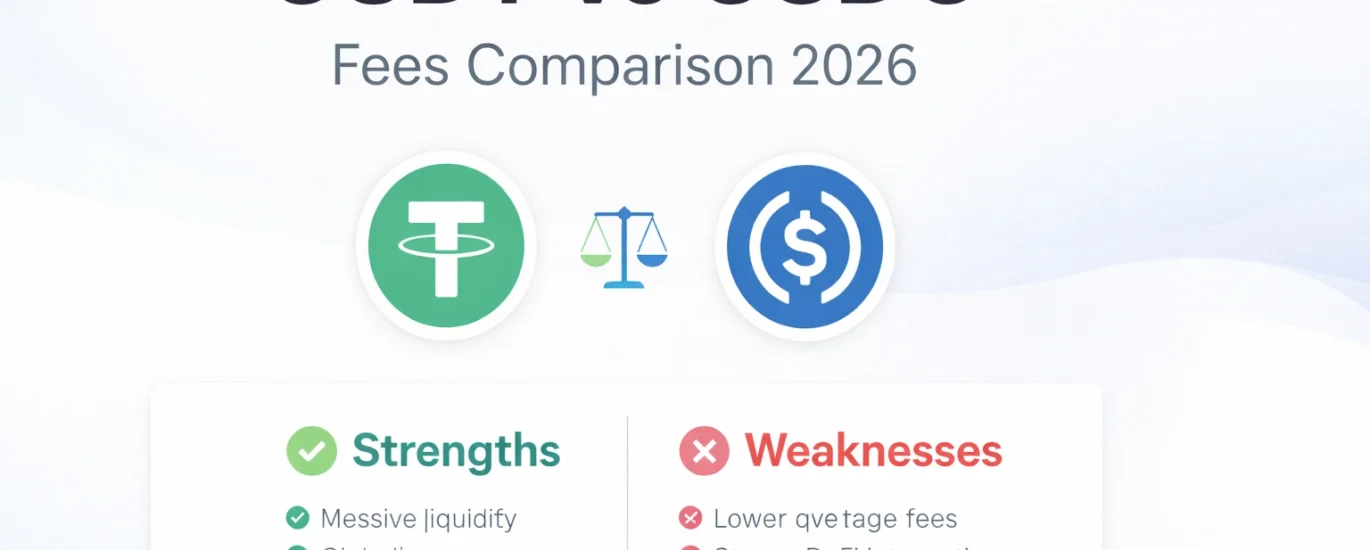
Stablecoin Evaluation
Dama DeFi SystemUSDT (Tether)
Best for liquidity, trading and global transfers.
- ✅ Massive liquidity
- ✅ Global acceptance
- ⚠️ Higher fees on Ethereum
- ⚠️ Lower transparency
USDC (USD Coin)
Best for efficiency, DeFi and low-cost networks.
- ✅ Lower average fees
- ✅ Strong DeFi integration
- ⚠️ Slightly less liquidity
- ⚠️ Not dominant in remittances
👉 USDT = movement (liquidity & transfers)
👉 USDC = optimization (fees & DeFi)
Smart users

FAQ: USDT vs USDC Fees (Complete Guide 2026)
1. Which is cheaper: USDT or USDC?
It depends on the network. USDT is usually cheaper on Tron (TRC-20), while USDC is often cheaper on Solana and Polygon.
2. Why are USDT fees sometimes higher than USDC?
Because USDT is widely used on Ethereum, where gas fees can fluctuate heavily and make transactions more expensive.
3. Are USDT and USDC transaction fees fixed?
No. Fees vary depending on the blockchain, network congestion, and exchange withdrawal policies.
4. What is the cheapest network to send USDT?
TRC-20 (Tron) is usually the cheapest option, often with a flat fee around 1 USDT.
5. What is the cheapest network to send USDC?
Solana and Polygon are typically the cheapest networks for USDC, often costing less than $0.01 per transaction.
6. Is USDC cheaper than USDT on Ethereum?
Sometimes. USDC can be slightly more efficient, but both depend heavily on Ethereum gas fees.
7. Why do fees vary so much between networks?
Each blockchain has different speed, architecture, and congestion levels, which directly affect transaction costs.
8. Are exchange fees different from network fees?
Yes. Exchanges charge trading and withdrawal fees, while blockchains charge network transaction fees.
9. What is a withdrawal fee in crypto?
It is the fee charged by an exchange when you move funds from the platform to your wallet.
10. Why is USDT so popular despite higher fees?
Because it offers massive liquidity and is supported by nearly every major exchange worldwide.
11. Is USDC safer than USDT?
Many users consider USDC more transparent and regulation-friendly, although both are widely used stablecoins.
12. Can I avoid fees completely when using stablecoins?
No. Even if network fees are low, you may still face spreads, withdrawal charges, or slippage.
13. What is the crypto spread?
It is the hidden difference between the buying and selling price, and it can be more expensive than the visible network fee.
14. Which stablecoin is better for remittances?
USDT on Tron is usually better for remittances because it is cheap, fast, and globally accepted.
15. Which stablecoin is better for DeFi?
USDC is often the stronger option for DeFi because it integrates well with lending, liquidity, and institutional-grade platforms.
16. Why is USDC popular in DeFi?
Because it has strong ecosystem support, lower transaction costs on efficient networks, and better compatibility with many DeFi protocols.
17. Do stablecoin fees change over time?
Yes. Fees can change depending on market demand, network usage, and exchange policies.
18. What is a gas fee in crypto?
A gas fee is the cost required to process a transaction on a blockchain such as Ethereum.
19. Is Tron better than Ethereum for stablecoin transfers?
For low-cost transfers, yes. But Ethereum remains stronger for advanced DeFi applications.
20. Can I send USDT and USDC on the same networks?
Sometimes, but not always. Availability depends on the wallet, exchange, and network support.
21. What happens if I send stablecoins to the wrong network?
You may lose access to your funds if the receiving wallet or exchange does not support that blockchain.
22. Are stablecoin transfers free inside exchanges?
Sometimes. Some exchanges allow free internal transfers between users on the same platform.
23. Which stablecoin is better for trading?
USDT is usually better for trading because it has higher liquidity and more trading pairs.
24. Which stablecoin is better for holding value?
Many users prefer USDC for longer-term storage because of its transparency and compliance image.
25. Do stablecoins have hidden fees?
Yes. Hidden fees may include spread, slippage, conversion costs, and expensive withdrawals.
26. What is slippage in crypto?
Slippage is the difference between the expected execution price and the actual price you receive during a trade or swap.
27. How can I reduce stablecoin fees?
Choose the right network, avoid unnecessary conversions, compare withdrawal fees, and use efficient blockchains like Tron, Solana, or Polygon.
28. Are stablecoins cheaper than bank transfers?
In many cases, yes — especially when using low-cost networks.
Related reading: USDT vs Bank Wire Transfer: Fees and Speed
29. What is the best low-fee strategy for using stablecoins?
A common strategy is to use USDT for transfers and liquidity, while using USDC for DeFi and low-cost ecosystems.
30. Where can I learn which network is best for USDT transfers?
Start with the pillar article: Best Network for USDT Transfers: Ethereum vs Tron vs Solana
About the Author