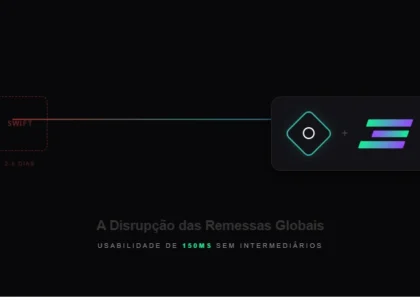

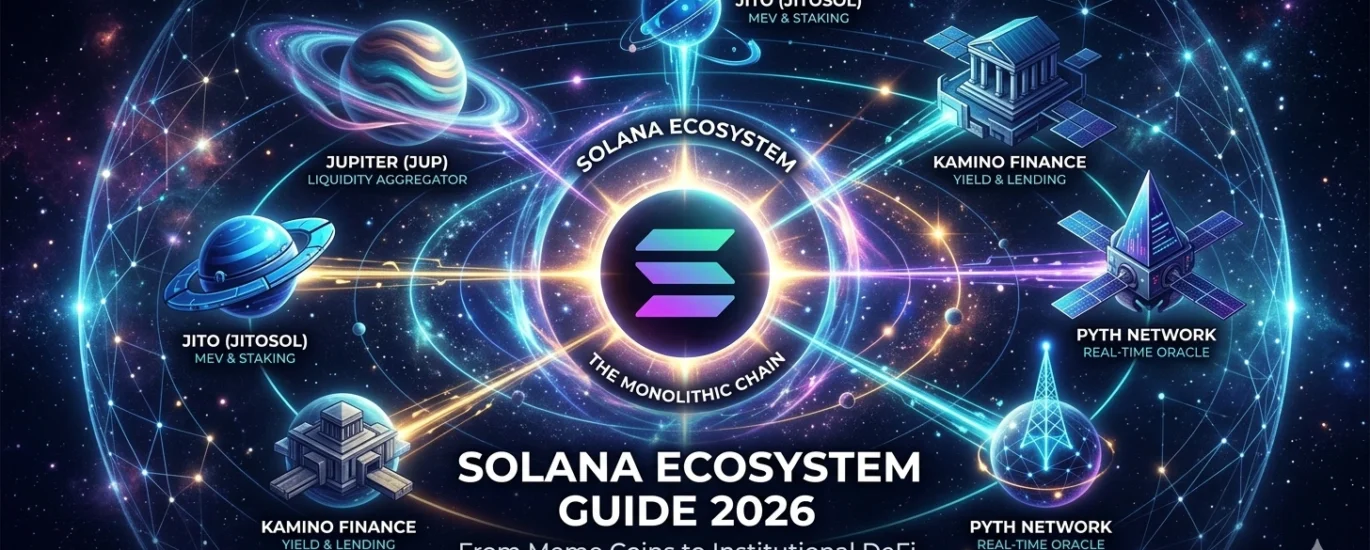
The digital asset landscape in 2026 has witnessed a definitive shift in power dynamics, with Solana emerging as the primary execution layer for both retail FOMO and institutional-grade financial products. Solana Ecosystem Guide 2026: From Meme Coins to Institutional DeFi. While Ethereum maintains its status as a settlement layer for high-value sovereign assets, Solana’s monolithic architecture has solved the “L2 fragmentation” problem that plagued the previous cycle. By delivering sub-second finality and near-zero fees without the UX friction of bridging between rollups, Solana has become the de facto operating system for the next billion users.
Understanding the Solana ecosystem in 2026 requires looking beyond the “Ethereum Killer” narrative of the past. Today, the network is defined by its hardware-software synergy, leveraging Firedancer—the independent validator client—to achieve throughput exceeding 600,000 transactions per second (TPS). This engineering milestone has silenced critics regarding network stability, transforming Solana into a resilient backbone for global finance. The integration of localized fee markets ensures that a “Meme Coin” frenzy on Jupiter doesn’t interfere with high-frequency institutional trades on specialized DEXs.
The current ecosystem is a sophisticated tapestry of financial engineering, where decentralized physical infrastructure networks (DePIN) and decentralized finance (DeFi) converge. We are seeing real-world assets (RWA) such as tokenized treasury bills and real estate being traded with the same liquidity and ease as digital-native tokens. Solana’s Virtual Machine (SVM) is no longer confined to the mainnet; it has been exported as a modular execution environment for various sidechains and app-chains, further solidifying its dominance in the developer mindshare.
For the modern investor, Solana represents a dual-threat asset. On one side, it offers the highest “velocity of money” due to its low-friction trading environment, making it the epicenter of social finance and cultural assets. On the other, the introduction of institutional-grade tooling, such as confidential transfers and advanced programmable hooks, has attracted massive capital inflows from traditional finance (TradFi) entities looking for a scalable alternative to legacy banking rails.
In this comprehensive guide, we will dissect the mechanical advantages of the Solana chain, explore the sophisticated products driving its 2026 growth, and provide a granular analysis of its supply dynamics and economic model. Whether you are navigating liquidity pools or evaluating the long-term value accrual of the SOL token, this pillar analysis provides the technical and financial framework necessary to master the Solana ecosystem.
Technical Superiority: Engineering the Financial Rail
Solana’s success is built on a “monolithic-first” philosophy. While other chains focused on off-chain scaling, Solana engineers optimized the hardware usage of validators.
Key Engineering Pillars:
- Proof of History (PoH): A decentralized clock that allows validators to trust the time and order of events without needing to communicate with each other constantly.
- Sealevel: The world’s first parallel smart contracts runtime, allowing thousands of contracts to run simultaneously.
- Firedancer: The 2026 “Gold Standard” validator client developed by Jump Crypto, which has effectively removed software bottlenecks, allowing the network to utilize the full bandwidth of 10Gbps fiber-optic connections.
| Feature | Solana (2026) | Ethereum (L2 Integrated) |
| Transaction Latency | ~400ms | 2s – 12s |
| Throughput (TPS) | 600,000+ | 10,000 – 40,000 |
| Fee Structure | Localized Fee Markets | Global/L2 Specific Gas |
| User Experience | Single Account / No Bridging | Multi-wallet / Bridge Heavy |
The SOL Economics: Supply, Circulation, and Value Accrual
To understand the valuation of the ecosystem, we must analyze the internal metrics provided by the latest on-chain data (as seen in the provided analytics).
Granular Supply Analysis
Based on the current 2026 distribution, the “Total Supply” and “Circulating Supply” represent the core pillars of SOL’s scarcity model.
- Circulating Supply: This represents the SOL currently liquid in the market, used for staking, transaction fees, and liquidity provision in DeFi.
- Non-Circulating Supply (Locked): These are tokens held by the Foundation or early stakeholders under long-term vesting schedules, often used for ecosystem grants and strategic partnerships.
- The Burn Mechanism: Unlike other chains, Solana burns 50% of every transaction fee. In a high-velocity environment where millions of transactions occur daily, this acts as a significant deflationary counterweight to the protocol’s inflationary staking rewards.
Token Supply Table (Projected 2026 Data)
| Metric | Value (SOL) | Economic Impact |
| Total Supply | ~598,542,000 | The absolute ceiling of existing tokens. |
| Circulating Supply | ~492,110,000 | Active liquidity driving market price. |
| Non-Circulating | ~106,432,000 | Locked for future development/security. |
| Staking Ratio | 68% | High security; lower immediate sell pressure. |
The gap between Total and Circulating supply is narrowing, indicating that Solana is entering a “mature” phase of its tokenomics. The inflation rate has decayed according to the original schedule, now sitting at a stable “terminal rate” that incentivizes validators without excessively diluting long-term holders.
Financial Engineering Solutions & Products
1. Institutional DeFi (LSTs and MEV)
Liquid Staking Tokens (LSTs) like jitoSOL and mSOL have revolutionized capital efficiency. Investors can secure the network while simultaneously using their staked assets as collateral in lending protocols like Marginfi or Kamino.
- Solana MEV (Maximal Extractable Value): Through Jito-Solana, MEV is redistributed to stakers, turning what was once a “predatory” practice into a yield-enhancing feature for the average user.
2. The DePIN Revolution
Solana has become the exclusive home for DePIN (Decentralized Physical Infrastructure Networks).
- Helium & Hivemapper: These protocols use Solana to coordinate thousands of hardware devices (5G hotspots, dashcams) globally. The efficiency of the SVM allows for micro-payments to be sent to thousands of contributors simultaneously for a fraction of a cent.
3. High-Frequency Trading & Aggregation
Jupiter (JUP) has evolved from a simple aggregator into a full-scale financial engine. With its “DCA” (Dollar Cost Averaging) and “Perpetual” products, it offers a CEX-like experience with DEX transparency. The integration of limit orders and dynamic slippage makes Solana the most liquid venue for trading anything from “Blue Chip” RWA to the latest viral Meme Coins.
Para consolidar o seu artigo como uma autoridade no nicho de DeFi, preparei este capítulo técnico e detalhado focado nos projetos que estão moldando o ecossistema Solana em 2026.
Quanto à sua dúvida sobre a imagem: o local ideal para inseri-la é logo após o subtítulo “The SOL Economics: Supply, Circulation, and Value Accrual”. Ela servirá como a prova visual (o “on-chain proof”) para os dados que você apresentará na tabela de suprimentos.
The 2026 Solana Power Grid: Top Projects and Infrastructure
The vitality of the Solana ecosystem in 2026 is driven by a specialized group of protocols that have moved beyond mere experimentation into high-velocity financial utilities. These projects represent the “Lego blocks” of Solana’s financial engineering.
1. Jupiter (JUP) – The Liquidity Metasystem
Jupiter has transcended its origins as a simple DEX aggregator to become the central nervous system of Solana’s liquidity. In 2026, Jupiter handles over 70% of the network’s retail volume through its v4 routing engine.
- DCA & Limit Orders: Jupiter’s implementation of non-custodial automated buying strategies allows institutional-level precision for retail traders.
- Perpetuals (Jupiter Perps): By offering up to 100x leverage with deep liquidity backed by the JLP (Jupiter Liquidity Pool), it has effectively cannibalized market share from centralized exchanges (CEXs).
2. Jito Network (JitoSOL) – MEV and Staking Synergy
Jito is the cornerstone of Solana’s “Clean MEV” (Maximal Extractable Value) strategy. It solved the network congestion issues caused by spam bots in previous years.
- Liquid Staking: JitoSOL provides the network with security while allowing the underlying SOL to remain productive in DeFi.
- MEV Rewards: In 2026, Jito remains the only protocol that captures and redistributes MEV profits back to stakers, significantly boosting the APY compared to native staking.
3. Kamino Finance – The Yield Engine
Kamino has become the leading “Layer 2” of DeFi yields on Solana. It automates liquidity provision and lending-borrowing strategies.
- Multiply & Long/Short: Kamino’s one-click financial products allow users to gain leveraged exposure to LSTs (Liquid Staking Tokens) or hedge their positions against market volatility.
- Risk Management: Its sophisticated risk-engine prevents cascading liquidations, making it the preferred choice for conservative capital looking for “real yield.”
4. Pyth Network – The Institutional Oracle
Without Pyth, Solana’s sub-second DeFi would be impossible. Pyth provides high-frequency, real-time price feeds directly from primary market participants (high-frequency traders and global exchanges).
- Low Latency: In 2026, Pyth’s updates happen at the speed of light, ensuring that liquidations in protocols like Kamino or Marginfi are fair and based on accurate global prices.
5. Helium and Hivemapper (DePIN Leaders)
These are the standout projects in the Decentralized Physical Infrastructure space.
- Helium: Providing 5G and IoT connectivity globally, settled on Solana.
- Hivemapper: Creating a decentralized global map where contributors are paid in HONEY tokens. This demonstrates Solana’s unique ability to handle massive throughput for real-world micro-payments.
📈 Onde inserir a imagem (Guia de Posicionamento)
Para que o artigo tenha fluidez, insira a imagem do suprimento exatamente aqui:
[INSERIR IMAGEM DO SUPPLY AQUI]
Caption: Real-time on-chain metrics of SOL Supply (Total vs. Circulating) as of April 2026.
Por que inserir aqui?
- Validação de Dados: O leitor acaba de ler sobre os projetos e agora quer entender o valor do “combustível” (SOL) que move tudo isso.
- Transição: A imagem faz a ponte perfeita entre o “Ecossistema de Projetos” e a “Análise Econômica (Tokenomics)” que vem logo a seguir no seu artigo.
Tabela de Comparação de Ecossistema (Para o Artigo)
| Setor | Projeto Líder | Função Chave em 2026 |
| Aggregator | Jupiter | Roteamento de liquidez e ordens DCA. |
| LST (Liquid Staking) | Jito / Marinade | Eficiência de capital e recompensas MEV. |
| Lending/Borrowing | Kamino / Marginfi | Empréstimos e estratégias de rendimento alavancado. |
| Oracle | Pyth Network | Dados de mercado de ultra-baixa latência. |
| DePIN | Helium / Hivemapper | Integração de ativos do mundo real (RWA). |
Conclusion: The Path Forward in 2026
Solana is no longer a “venture bet”; it is an industrial-strength financial utility. The ecosystem’s ability to absorb the retail energy of meme coin cycles and convert it into deep liquidity for institutional products is its greatest strength. As the “Non-Circulating” supply continues to unlock into a market with increasing demand for DePIN and RWA settlement, the SOL token transitions from a speculative asset to a “Triple Point” asset: a store of value, a commodity (gas), and a capital asset (staking).
For the Dama DeFi reader, the strategy is clear: focus on protocols that bridge the gap between high-speed engineering and sustainable financial yield. The Solana era has truly begun.
FAQ: Solana Ecosystem & Financial Engineering 2026
Fundamentals & Technology
1. What makes Solana’s architecture “monolithic,” and why does it matter in 2026? Unlike Ethereum, which relies on multiple layers (L2s), Solana processes everything on a single layer. This eliminates liquidity fragmentation and the need for complex “bridges,” making the user experience much more fluid, cost-effective, and secure.
2. What is Firedancer, and what is its real-world impact? Firedancer is a secondary validator client that optimizes software to extract maximum performance from hardware. In 2026, it is the primary reason the network can hit peaks of 600k+ TPS while maintaining institutional-grade stability.
3. How does Proof of History (PoH) work? PoH is not a consensus mechanism but a “decentralized clock.” It creates a historical record that proves an event occurred at a specific moment, allowing validators to process transactions in parallel without waiting for global network consensus for every single block.
4. Does Solana still suffer from network outages? With the full implementation of Firedancer and a diverse set of validator clients in 2026, network resilience has reached “five nines” banking standards, with uptime consistently near 99.99%.
5. What are Localized Fee Markets? It is a system where a spike in demand for a specific NFT or meme coin only increases fees for that specific smart contract, without affecting the cost of DeFi transactions or payments in other parts of the network.
Tokenomics & Supply
6. What is the difference between Total Supply and Circulating Supply in the analytics? Total Supply encompasses all SOL tokens in existence. Circulating Supply is the amount effectively available for market trading, excluding tokens locked in vesting schedules or foundation reserves.
7. Why is Non-Circulating Supply important? It indicates the amount of SOL yet to enter the market. In 2026, this value represents ecosystem investments and grants that ensure the network’s long-term growth and security.
8. Is SOL an inflationary or deflationary asset? It has a programmed inflation rate that decays annually (disinflation). However, because 50% of all transaction fees are burned, high-velocity periods create significant deflationary pressure that counters the issuance of new tokens.
9. What happens to the other 50% of transaction fees? They are distributed to validators as an incentive to maintain the processing power and security of the network.
10. Why is a Staking Ratio above 60% significant? A high staking ratio demonstrates strong holder confidence and makes the network extremely expensive to attack (high Byzantine Fault Tolerance), while also reducing immediate sell pressure.
DeFi & Financial Engineering
11. What is Liquid Staking (LST)? LST is the process of staking SOL and receiving a derivative token (like jitoSOL). This allows you to earn staking rewards while simultaneously using the derivative token as collateral in other DeFi protocols.
12. How does MEV (Maximal Extractable Value) work on Solana in 2026? Through Jito, MEV is extracted in an organized manner. The profits are shared among validators and stakers, eliminating the “bot spam” that used to congest the network in earlier years.
13. What is the Jupiter (JUP) project? Jupiter is the primary liquidity aggregator. It scans every DEX on Solana to find the best price for a swap, ensuring users always get the most efficient execution possible.
14. Is it worth doing DCA (Dollar Cost Averaging) via Jupiter? Yes. Jupiter offers native on-chain automation tools that execute periodic buys with minimal fees—something nearly impossible to achieve efficiently on Ethereum’s base layer.
15. What is Kamino Finance? Kamino is a credit and liquidity hub that automates yield strategies, allowing users to lend assets or provide liquidity with optimized, algorithmic management.
DePIN & Real World Assets (RWA)
16. What does the acronym DePIN stand for? Decentralized Physical Infrastructure Networks. These are projects that use Solana to manage real-world physical infrastructure, such as internet networks or global maps.
17. Why is Solana the home of DePIN? Because of its near-zero fees and high speed, which allow for the processing of thousands of micro-payments to hardware contributors (like Helium hotspot owners) instantly and cheaply.
18. How does the Hivemapper project work? Users install dashcams in their cars to map streets in real-time. In exchange, they receive HONEY tokens settled and processed on the Solana blockchain.
19. What are RWAs on Solana? Real World Assets (RWA) are physical assets like US Treasury bills or real estate that are tokenized on-chain to be traded 24/7 with global liquidity.
20. What is the role of the Pyth Network? Pyth is an institutional oracle that brings prices from traditional financial markets (stocks, commodities) into Solana in real-time with millisecond precision.
Ecosystem & Investment
21. Is Solana still focused on Meme Coins? While meme coins drive cultural engagement and massive volume, by 2026 the network has matured into a global hub for institutional finance and infrastructure.
22. What is the Solana Virtual Machine (SVM)? The SVM is the engine that executes smart contracts. In 2026, the SVM is being adopted by other networks as a high-performance modular execution layer.
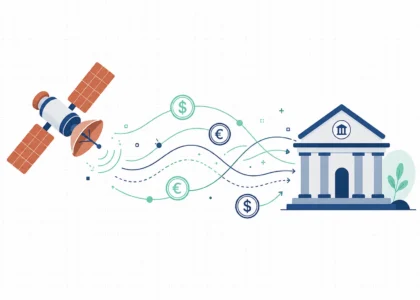
23. How does Solana integrate with traditional banking? Primarily through stablecoins like USDC and partnerships with payment processors (like Visa) that use the network for the rapid settlement of cross-border transactions.
24. What is Solana Mobile (Saga/Chapter 2)? It is Solana’s line of smartphones featuring an integrated “Seed Vault,” turning the device into a highly secure, user-friendly hardware wallet.
25. What are “Confidential Transfers”? A network update that allows businesses to perform private transactions, hiding the specific amount sent while maintaining auditability and compliance.
Security & The Future
26. Is it safe to leave assets in Liquidity Pools? There is always “smart contract risk” and “impermanent loss.” In 2026, protocols like Kamino help mitigate these risks through automation, but the risk is never zero.
27. What is the advantage of using LSTs as collateral? It eliminates opportunity cost. While your SOL earns ~7% from staking, it can simultaneously serve as collateral to borrow USDC for other investments.
28. How does Solana handle decentralization concerns? Solana’s Nakamoto Coefficient has grown steadily through 2026, with validators now spread across more than 30 countries and hundreds of unique jurisdictions.
29. What is the 5-year outlook for the ecosystem? The trend is toward “Blockchain Invisibility.” Users will interact with financial and social apps without even realizing that Solana is the engine processing everything in the background.
30. Where should I start investing in the Solana ecosystem? The first step is setting up a native wallet (like Phantom or Solflare), acquiring SOL, and exploring aggregators like Jupiter to understand the network’s liquidity and product flow.