

Skin in the Game: Why We Write This
In the world of DeFi, “alpha” is often buried under layers of marketing jargon and complex UI. We aren’t just technical writers; we are active participants in the Solana ecosystem. Our capital is deployed in the same liquidity vaults and looping strategies we discuss here. We’ve felt the sting of liquidation during flash crashes and the thrill of optimized compounding. This guide isn’t theoretical—it’s a tactical manual for those who, like us, believe that code is law and transparency is the only currency that matters.
Understanding the Kamino Architecture
Kamino Finance has evolved into the “liquidity engine” of Solana. Unlike early-generation AMMs, Kamino integrates lending, automated liquidity management, and leverage into a single, unified interface. The protocol’s core strength lies in its Lend V2 infrastructure, which utilizes isolated markets to prevent contagion risk while maximizing capital efficiency through Elevation Mode.
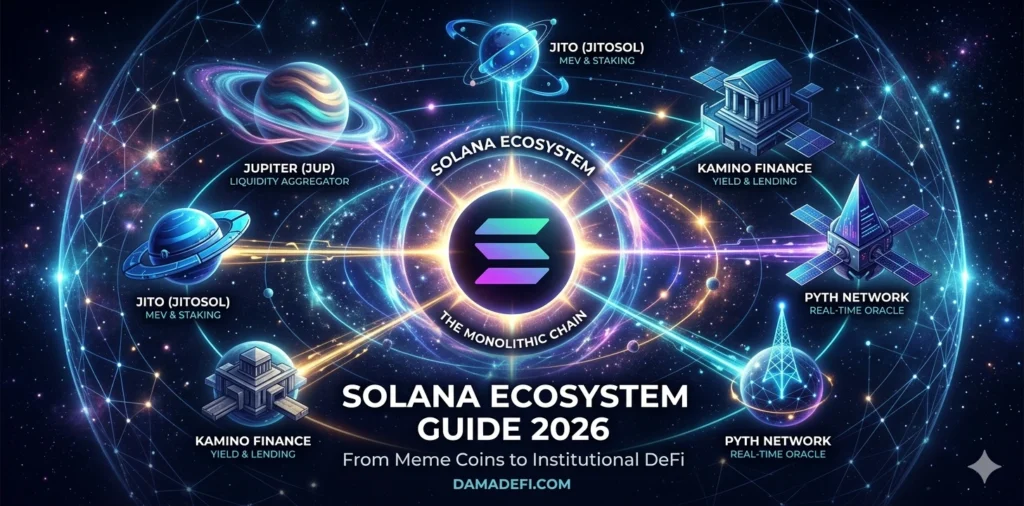
The Future of Solana, Unfiltered. From high-velocity memes to the backbone of institutional DeFi. Master the ecosystem with our 2026 definitive guide.
[ Read the Guide ] Simple, direct, and decentralized. — damadefi.com/solana-ecosystem-guide-2026/
The Mechanics of Multiply
Kamino Multiply is essentially “Leverage-as-a-Service.” It uses flash loans to automate the process of “looping.”
- Deposit: You provide collateral (e.g., JitoSOL).
- Flash Loan: The protocol takes a flash loan of the debt asset (e.g., SOL).
- Swap & Re-deposit: The borrowed asset is swapped for more collateral and deposited.
- Finalize: The final position is a leveraged exposure to the yield of the collateral asset minus the cost of the debt.
JLP: The “House” Edge
The Jupiter Liquidity Provider (JLP) token is a basket of assets (SOL, BTC, ETH, USDC, USDT) that acts as the counterparty to traders on Jupiter Perps. By holding JLP, you earn 75% of the fees generated by the platform. When you bring JLP into Kamino, you can use it as collateral to borrow stables and buy more JLP, creating a high-yield loop.
Technical Comparison: Multiply vs. JLP Looping
To choose the right strategy, you must understand the underlying math. Multiply strategies are generally more “directional” or “correlated,” whereas JLP is a play on market volatility and trading volume.
Comparative Table: Performance & Risk (April 2026)
| Metric | Multiply (JitoSOL/SOL) | JLP Looping (JLP/USDC) |
| Typical APY | 8% – 15% | 25% – 45% |
| Leverage Cap | Up to 10x (e-Mode) | Up to 3x (Recommended) |
| Main Risk | De-pegging of LST | JLP price drawdown / Trader PnL |
| Liquidation LTV | ~90% | ~85% |
| Fee Structure | 0.001% Flash Loan fee | Lending spread + Jupiter fees |
Strategic Deep Dive: The “Multiply” Framework
When using Multiply, your primary goal is to capture the spread between a yield-bearing asset and its base currency.
1. The LST Loop (Low Risk)
Using assets like JitoSOL or mSOL against SOL. Because the assets are highly correlated, the risk of liquidation is minimal unless the LST “de-pegs” significantly from SOL. In 2026, with the maturation of Solana’s validator set, these de-pegs are rare but not impossible.
2. The Stablecoin Multiply (Market Neutral)
Leveraging PYUSD or USDC against each other. This is a “cash and carry” style strategy. You are essentially mining protocol incentives (KMNO points or partner rewards) with near-zero price exposure.
Maximizing JLP: The Advanced Looper’s Playbook
JLP is the “gold standard” for yield on Solana, but it is not a “set and forget” asset. Because JLP contains SOL, BTC, and ETH, its price fluctuates with the market.
Risk Management for JLP
- Debt Selection: Always borrow USDC or USDT against JLP. Borrowing SOL against JLP exposes you to “double volatility” if SOL outpaces the other assets in the JLP basket.
- Oracle Resilience: Kamino uses a blend of Pyth and Switchboard oracles with EWMA (Exponentially Weighted Moving Average) smoothing. This prevents “scam wicks” from triggering liquidations during periods of extreme volatility.
Protocol Security & Audits
Kamino’s TVL of $2.8B is protected by a multi-layered security stack:
- Continuous Audits: Latest reports from OtterSec and Certora (March 2026) confirm the integrity of the Lend V2 smart contracts.
- Whitelisted Reserves: A 2026 update allows the protocol to restrict exposure to specific assets at the contract level, preventing “bad debt” from illiquid tokens.
Step-by-Step: Executing the Strategy
- Connect: Use a hardware-secured wallet (like Ledger or Trezor) via Phantom.
- Select “Multiply”: Navigate to the Multiply tab and choose your pair (e.g., JLP/USDC).
- Adjust Leverage: Use the slider to set your leverage. For JLP, we recommend staying below 2.2x to survive a 20% market correction.
- Monitor Health Factor: Keep your Health Factor above 1.5. If it drops toward 1.1, be prepared to add more collateral or deleverage.
Mastering the Interface: The Kamino Liquidity Engine
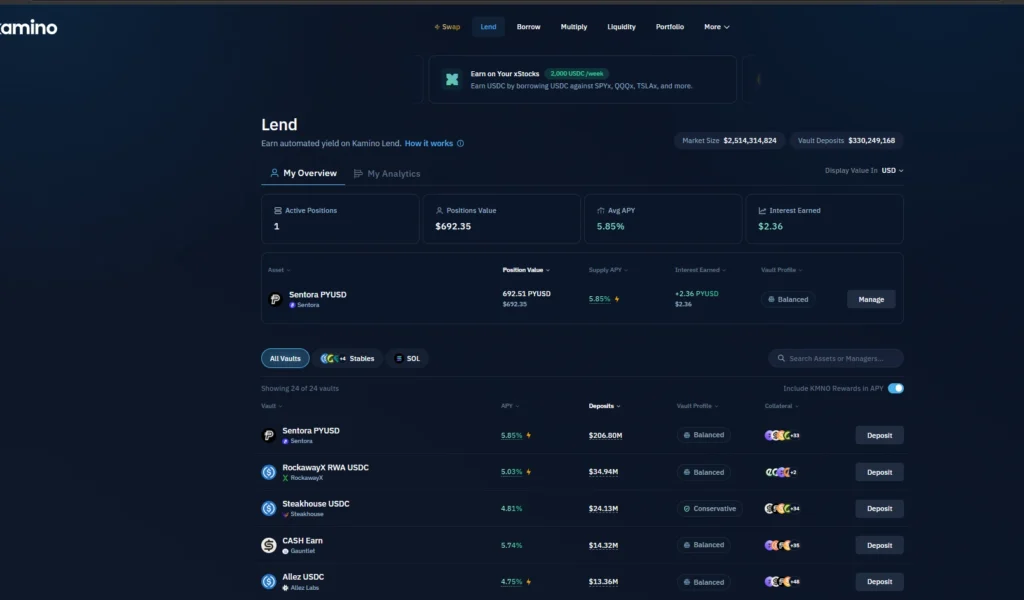
The image below illustrates the functional core of Kamino Finance, specifically the Lend section, where capital efficiency begins.
![Alt Text: Screenshot of the Kamino Finance interface showing the ‘Lend’ panel. At the top, a banner highlights earnings on xStocks. Below, the account overview displays an active position of $692.35 with a 5.85% APY. The vault list includes Sentora PYUSD, RockawayX RWA USDC, and Steakhouse USDC with their respective yields and total deposits.]
Caption: The Kamino user interface in 2026, highlighting the integration of Real World Assets (RWA), stablecoins like PYUSD, and the real-time position monitoring system.
Technical Analysis of Visible Products
By observing the dashboard, we can identify the pillars that support high-yield strategies:
- Stablecoin Vaults (PYUSD/USDC): Note the Sentora PYUSD vault. With a 5.85% APY, it serves as a solid base for low-risk strategies or as high-quality collateral for Multiply operations. The use of PYUSD (PayPal USD) demonstrates the protocol’s deep integration with institutional assets.
- RWA (Real World Assets): The RockawayX RWA USDC product indicates Kamino’s expansion beyond crypto-native tokens. This allows users to earn yields backed by tokenized traditional financial instruments, diversifying the source of the “yield.”
- Automated Management (Vault Profile): Notice the labels such as “Balanced” and “Conservative.” Kamino automates collateral rebalancing to ensure that even during high market volatility, the risk of vault insolvency is minimized.
- KMNO Incentives: In the top right corner, the “Include KMNO Rewards” toggle shows that total yield is often boosted by governance tokens—a critical strategy for maximizing ROI during the 2026 bull market.
- xStocks Integration: The top banner regarding xStocks ($2,000 USDC/week) showcases Kamino’s evolution into a cross-chain asset hub, where users can leverage synthetic stocks (like SPY or TSLA) to generate on-chain liquidity.
Comprehensive FAQ: Kamino Finance, Multiply, and JLP Strategies
1. What is Kamino Finance? Kamino Finance is a decentralized finance (DeFi) protocol on the Solana blockchain that unifies lending, borrowing, and concentrated liquidity management into a single, automated capital efficiency engine.
2. How does the “Multiply” feature work? Multiply uses flash loans to automate the process of “looping” an asset. It borrows a debt asset against your collateral to buy more of that collateral, effectively increasing your exposure and yield in a single click.
3. What is JLP (Jupiter Liquidity Provider)? JLP is a basket of assets (SOL, BTC, ETH, USDC, and USDT) that acts as the liquidity source for Jupiter’s perpetual exchange. Holders earn 75% of the platform’s trading fees.
4. Is Kamino Multiply the same as traditional margin trading? While both involve leverage, Multiply is specifically designed to amplify yield-bearing positions (like LSTs or JLP) by capturing the spread between the asset’s yield and the cost of borrowing.
5. What is “Elevation Mode” (e-Mode)? Elevation Mode is a risk management feature that allows for much higher Loan-to-Value (LTV) ratios (up to 95%) when the collateral and debt assets are highly correlated, such as two different stablecoins or SOL and a liquid staking token.
6. Can I get liquidated on Kamino? Yes. If the value of your collateral falls below the liquidation threshold relative to your debt, the protocol will sell your collateral to repay the loan. Always monitor your “Health Factor.”
7. Why should I borrow USDC against JLP instead of SOL? Borrowing USDC creates a “stable” debt. If you borrow SOL and the price of SOL rises faster than the JLP basket, your debt increases in value, which can quickly lower your Health Factor and lead to liquidation.
8. What are the risks of JLP looping? The main risks include a drop in the price of the underlying assets (SOL, BTC, ETH) and the potential for traders on Jupiter to have a winning streak, which can temporarily reduce the JLP token’s value.
9. How does Kamino handle price oracles? Kamino uses a combination of Pyth and Switchboard oracles. It also implements Exponentially Weighted Moving Average (EWMA) smoothing to prevent flash crashes or “scam wicks” from triggering unfair liquidations.
10. What are the fees associated with these strategies? Users typically pay a small flash loan fee (0.001%) when opening a Multiply position, along with the interest rate spread between what you earn on collateral and what you pay for the debt.
11. What is the “Health Factor” on my dashboard? The Health Factor is a real-time safety score. If it reaches 1.0, your position becomes eligible for liquidation. A factor above 1.5 is generally considered safe for most volatile strategies.
12. Are the yields on Kamino sustainable? Yields come from real economic activity: trading fees from Jupiter (for JLP), lending interest from other borrowers, and protocol incentives (KMNO tokens). They fluctuate based on market demand.
13. What is a Liquid Staking Token (LST)? An LST, like JitoSOL or mSOL, represents SOL staked with a validator. It earns staking rewards while remaining liquid, allowing you to use it as collateral in Kamino.
14. Can I use Kamino on mobile? Yes, Kamino is fully compatible with Solana mobile wallets like Phantom and Solflare through their built-in dApp browsers.
15. How do I exit a leveraged Multiply position? You can use the “Close” or “Deleverage” button on your dashboard. The protocol will automatically sell a portion of your collateral to repay the debt and return the remaining balance to you.
16. Does Kamino have its own token? Yes, the KMNO token is used for governance within the Kamino DAO, allowing holders to vote on protocol parameters and incentive distributions.
17. What is “Bad Debt” and how does Kamino prevent it? Bad debt occurs when a position’s collateral is worth less than the debt. Kamino prevents this through aggressive liquidation bots and isolated lending markets to ensure one failing asset doesn’t affect the whole protocol.
18. What are xStocks on the Kamino interface? xStocks are synthetic representations of traditional stocks (like Tesla or Nvidia). Kamino allows users to borrow against these or earn yield on them, bridging the gap between TradFi and DeFi.
19. How do I know if a vault is “Balanced” or “Conservative”? Kamino labels vaults based on their risk parameters (LTV, asset volatility, and liquidity). Conservative vaults have lower limits and safer assets, while Balanced vaults allow for more aggressive yield strategies.
20. Is my capital locked when I deposit? No, you can generally withdraw your funds at any time, provided they are not being used as collateral for an active loan that would become undercollateralized upon withdrawal.