
![Uma imagem de capa hero minimalista e elegante em 1200x600 pixels para damadefi. O fundo é branco gelo limpo com elementos metálicos dourados sutis. À esquerda, o título principal em dourado: "Solend vs. Marginfi: Which is the Safest Lending Protocol on Solana?". Abaixo, o texto CTA "Learn and Earn. Simple, Direct, and Decentralized. [ Read the Guide ]". À direita, dois ícones conceituais em dourado: uma caixa-forte metálica dourada representando a segurança de pools do Solend e um motor de engrenagem e rede representando o motor de risco global do Marginfi, ambos brilhantes e sofisticados. O logotipo "damadefi" e o ícone Solana estão sutilmente posicionados no canto inferior direito.](https://damadefi.com/wp-content/uploads/2026/04/Gemini_Generated_Image_dm94pcdm94pcdm94-1370x550.webp)
Skin in the Game: More Than Just Words
In the Solana ecosystem, “safe” is a relative term. We don’t just monitor these protocols from the sidelines; we have active capital deployed across both Solend and Marginfi. We’ve navigated the 2022 liquidations and the 2024 airdrop seasons, and we continue to manage five-figure positions in these lending markets. This isn’t a paid review—it’s a battlefield report from investors who care about capital preservation as much as APY.
The Architecture of Safety: Solend (Save) vs. Marginfi
When evaluating safety in DeFi, the primary concern isn’t just the code, but the economic design. As of 2026, both protocols have matured, but they handle risk in fundamentally different ways.
Solend (Rebranded as Save): The Battle-Tested Veteran
Solend—now often referred to by its new brand, Save—is the oldest lending protocol on Solana. Its safety is rooted in its longevity. Having survived multiple network outages and the FTX contagion, its smart contracts are among the most scrutinized in the industry.
- Main Pool: A cross-collateralized pool with conservative LTV (Loan-to-Value) ratios.
- Isolated Pools: These allow for riskier assets (like meme coins) to be traded without endangering the Main Pool’s solvency.
Marginfi: The Institutional Approach
Marginfi was built with a “risk-first” mentality. Unlike legacy protocols that rely on reactive liquidations, Marginfi’s mrgnlend uses a sophisticated risk engine that monitors liquidity depth in real-time.
- Contagion Prevention: By using strictly isolated markets for non-blue-chip assets, Marginfi ensures that a “black swan” event in a small token doesn’t drain USDC or SOL from the platform.
Technical Comparison: TVL, Audits, and Risk Oracles
Security is a cat-and-mouse game. In 2026, hackers use AI to probe for logic errors, making the audit history and oracle resilience more critical than ever.
Safety Metrics & Comparative Table (April 2026)
| Feature | Solend (Save) | Marginfi |
| TVL (Est. 2026) | $580M | $410M |
| Primary Audits | Kudelski, OtterSec, Halborn | OtterSec, Zell-W |
| Oracle Provider | Pyth + Switchboard | Pyth (with EWMA smoothing) |
| Risk Model | Pool-based Isolation | Global Risk Engine + Isolated Markets |
| Insurance Fund | Limited / Treasury-backed | Protocol-native Risk Buffer |
Oracle Resilience: The Unsung Hero
A protocol is only as safe as its price feed. Solend uses a redundant oracle setup, which is great for uptime. Marginfi, however, utilizes Exponentially Weighted Moving Average (EWMA) prices. This prevents “scam wicks”—sudden, artificial price drops—from triggering massive, unnecessary liquidations.
The Financial Engineering of Solend: The Interest Rate Machine
Solend, now transitioning into the Save ecosystem, represents the “Old Guard” of Solana’s financial infrastructure. To understand why it remains a top-tier choice for institutional and retail capital alike, one must look at the specific engineering that powers its “Interest Rate Machine.”
[Image Title: Solend (Save) – The Autonomous Interest Rate Machine for Lending]
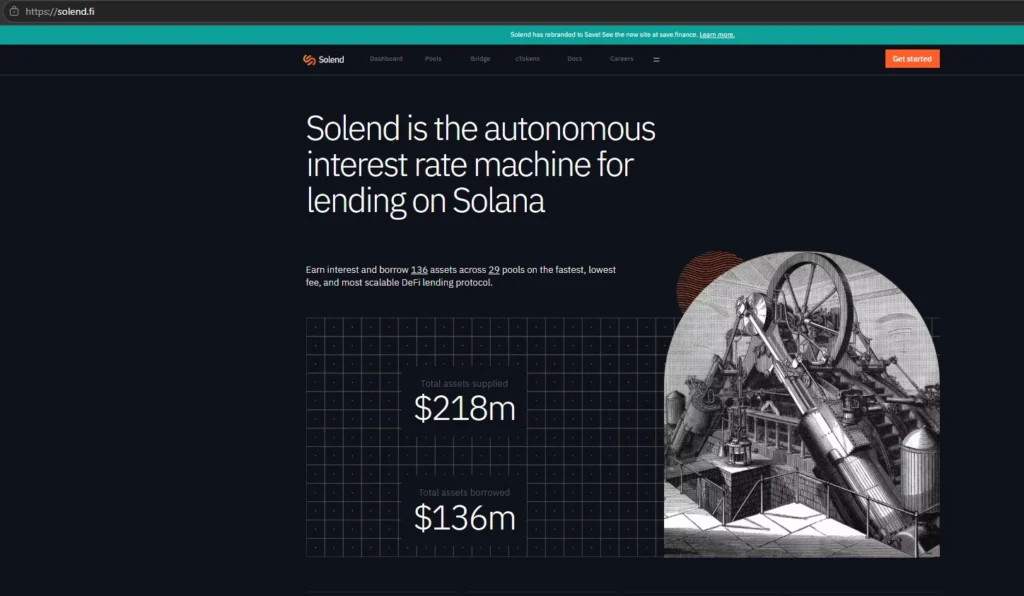
![Alt Text: Screenshot of the Solend.fi landing page. The header features the rebranding banner to ‘Save’. Large typography reads ‘Solend is the autonomous interest rate machine for lending on Solana’. The dashboard shows Total Assets Supplied at $218M and Total Assets Borrowed at $136M. A vintage industrial machine illustration on the right symbolizes the automated nature of the protocol.]
Caption: The Solend (Save) architecture utilizes automated algorithmic curves to balance liquidity and debt across 29 specialized pools.
Architectural Deep Dive: How the Machine Works
The engineering behind Solend isn’t just about moving tokens; it’s about algorithmic equilibrium. Here are the core components:
- Dynamic Interest Rate Curves: Unlike traditional banking where rates are set by committees, Solend uses a mathematical curve. As the “Total Assets Borrowed” ($136M) approaches the “Total Assets Supplied” ($218M), the interest rate spikes exponentially. This engineering ensures that lenders are always incentivized to provide liquidity when the system is strained, preventing bank runs.
- Utilization-Based Efficiency: Looking at the image, we can see a Utilization Rate of approximately 62%. This is a “sweet spot” in financial engineering. It means there is enough liquidity for lenders to withdraw instantly, but enough borrowing activity to generate competitive APYs for the suppliers.
- Isolated Risk Management (The Pool System): Solend’s primary innovation is the use of Isolated Pools. While the Main Pool handles blue-chip assets like SOL and USDC, specialized pools allow for higher-risk assets to be borrowed without creating “Contagion Risk.” If a small-cap token in a Turbo Pool crashes, the engineering ensures that the Main Pool—and your primary savings—remain unaffected.
- Transition to Save.finance: The banner at the top of the image indicates a strategic pivot. The engineering is evolving from simple lending into a comprehensive “Savings” layer. This includes SValue tokens and fixed-term yield products, designed to provide a more predictable financial experience for users who prioritize capital preservation.
Why Engineering Matters for Safety
In the world of DeFi, Code is Law. Solend’s engineering has been battle-tested through the FTX collapse and numerous Solana congestion events. By maintaining a transparent, open-source machine that calculates risk in real-time, it removes human error from the lending equation.
Usability vs. Security: The Investor’s Dilemma
Safety isn’t just about code; it’s about not making mistakes. A confusing UI can lead to accidental over-leveraging.
Solend’s UX: Simple and Direct
Solend (Save) has focused on a “set and forget” experience. Its interface is clean, making it difficult to accidentally open a high-risk position. For conservative lenders seeking to earn 5-8% on USDC, it remains the gold standard for simplicity.
Marginfi’s UX: Data-Heavy and Precise
Marginfi provides more data points: “Lending Capacity,” “Global Health,” and “Borrow Power.” While this is better for professional traders, beginners might find it overwhelming. However, this transparency is a safety feature—it allows you to see exactly how close the protocol is to its limits.
The 2026 Verdict: Which Should You Use?
If you are an institutional-style investor or someone who manages large amounts of capital, Marginfi’s proactive risk engine and isolated architecture offer a slight edge in “Black Swan” resilience.
If you are a retail investor looking for deep liquidity and a proven track record of surviving the worst market conditions, Solend (Save) is the most battle-tested home for your assets.
People Also Ask (FAQ)
1. Is Solend safer than Marginfi?
Both are highly secure. Solend has a longer history, while Marginfi has a more modern, proactive risk management engine.
2. Has Solend ever been hacked?
Solend has not suffered a major smart contract exploit, though it has faced “bad debt” situations during extreme market volatility.
3. What happens if Marginfi’s oracle fails?
Marginfi uses Pyth with internal price smoothing to prevent a single bad data point from causing liquidations.
4. Can I lose my principal on these platforms?
Yes. While rare, smart contract bugs or extreme market crashes that lead to protocol insolvency can result in loss of funds.
5. Who audits these protocols?
Both are audited by top firms like OtterSec. You can find their latest 2026 reports on their respective GitHubs.
6. What is “Bad Debt” in Solana lending?
It occurs when the value of a borrower’s collateral falls faster than it can be liquidated, leaving the protocol with a loss.
7. Does Marginfi have a token?
As of 2026, the MRGN token is used for governance and risk-buffer staking.
8. Is my money insured?
No. DeFi lending is non-custodial and generally does not come with FDIC-style insurance.
9. Which protocol has higher APY?
Rates change every second based on supply and demand. Generally, they are within 1% of each other for major assets.
10. What is an “Isolated Market”?
A lending pool where only specific assets can be used, preventing a crash in one token from affecting the whole platform.
11. Is Solend rebranded as Save?
Yes, the team rebranded to Save.Finance in late 2024 to reflect a broader suite of financial products.
12. What is the minimum deposit?
There is no minimum, but transaction fees (though low on Solana) make deposits under $10 inefficient.
13. Can I use these protocols on my phone?
Yes, both have excellent mobile-responsive sites and integrate with the Phantom wallet.
14. What is the Health Factor?
A number representing how close you are to liquidation. 1.0 is the danger zone; stay above 1.5.
15. Is Solana DeFi safe in 2026?
The ecosystem has matured significantly, but “smart contract risk” is always present in any decentralized application.
Exclusive CTAs for Dama DeFi Readers
Explore the Pillar Guide
Master the Solana Ecosystem 2026
From retail hype to institutional infrastructure. Everything you need to know to stay ahead.
Simple. Direct. Decentralized.
Strategy Deep Dive
Jupiter (JUP) & LFG Launchpad
Learn how to find the next 100x gem on Solana’s premier launchpad.
Manage Your Portfolio
Advanced Portfolio Dashboard
Ready to track your Solend and Marginfi positions in one place?
[ Access Dashboard ]