
What Is On-Chain Settlement?
On-chain settlement means that a transaction is finalized directly on a blockchain network. There is no post-processing. No internal clearing delay. No reconciliation between correspondent banks.
Once a transaction is confirmed in a block, settlement is complete.
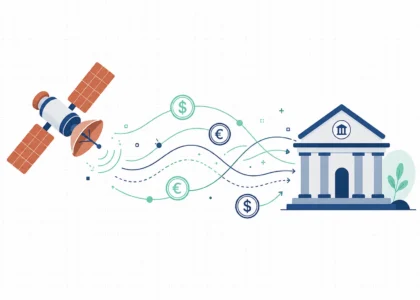
In traditional banking, payment flows look like this:
- Sender’s bank
- Correspondent bank
- SWIFT messaging layer
- Receiving bank
- Clearing and reconciliation
In blockchain-based systems:
- Wallet A → Network → Wallet B
- Final settlement recorded on-chain
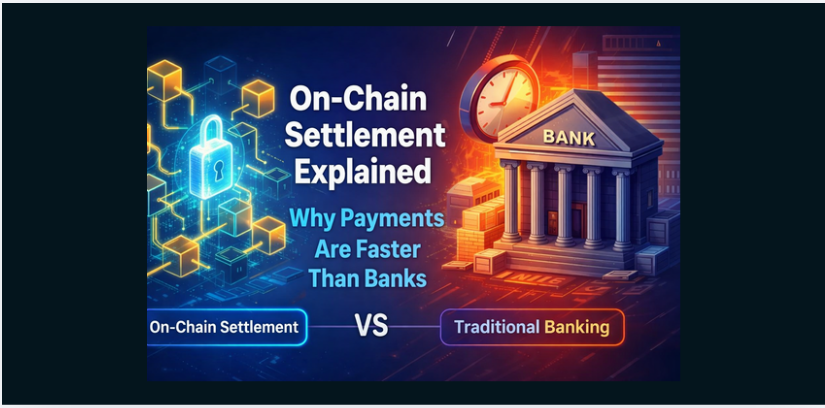
This structural difference is why on-chain settlement enables instant global payments.
Why Are Bank Payments Slower?
Banks operate on clearing systems. Even when a payment appears “instant,” underlying settlement may still be pending between institutions.
International bank transfers typically involve:
- 1–5 business days
- Multiple intermediary fees
- Currency conversion spreads
- Banking hours and cut-off times
On-chain settlement operates differently:
- 24/7 availability
- Minutes to confirmation
- Transparent network fees
- No correspondent banks
To understand how stablecoins are replacing legacy rails like SWIFT, read the cluster pillar:
📦 CLUSTER PILLAR
👉 Instant Global Payments: How USDT, USDC and PYUSD Are Replacing SWIFT
How Stablecoins Enable Faster Settlement
Stablecoins such as USDT, USDC, and PYUSD operate on public blockchains like Ethereum, Solana, and Tron.
This enables:
- Immediate ledger recording
- Global accessibility
- Real-time verification
- Direct peer-to-peer transfers
If you want a deeper understanding of PayPal’s stablecoin and when it makes sense to use it:
🔗 PYUSD Explained: What It Is and When It Makes Sense
On-Chain Settlement vs SWIFT: Direct Comparison
| Feature | On-Chain Settlement | SWIFT |
|---|---|---|
| Settlement Speed | 1–10 minutes | 1–5 business days |
| Intermediaries | None | Multiple banks |
| Availability | 24/7 | Banking hours |
| Transparency | Public ledger | Opaque |
| Finality | Cryptographic | Institutional |
For a deeper comparison of fees and speed:
🔗 SWIFT vs Stablecoins: USDT vs USDC Fees and Speed Comparison
Real-World Use Case: Sending Money Abroad
Imagine sending $1,000 internationally.
Traditional banking:
- $25–$50 transfer fee
- 2–4% FX spread
- 2–5 day delay
Stablecoin on-chain settlement:
- Network fee: often under $5 (sometimes cents on Solana/Tron)
- Near-instant delivery
- Dollar-denominated value
- Immediate usability
For step-by-step instructions:
🔗 How to Send Money Abroad with USDT (Step-by-Step + Costs)
And if you’re comparing safety and cost:
🔗 USDC vs USDT for Remittances: Which Is Safer and Cheaper?
Why On-Chain Settlement Is Structurally Faster
Speed is not just technical. It’s architectural.
Traditional finance depends on:
- Interbank trust layers
- Delayed reconciliation
- Regulatory batching
- Settlement windows
Blockchain networks rely on:
- Distributed consensus
- Cryptographic validation
- Shared public ledger
- Deterministic finality
There is no “waiting for approval.” The network validates mathematically.
When On-Chain Settlement Makes the Most Sense
On-chain settlement is ideal when:
- You need cross-border transfers
- You operate globally
- You require 24/7 liquidity
- You want cost transparency
- You need programmable payments
However, it may not be necessary for:
- Domestic same-bank transfers
- Low-frequency personal payments
- Situations requiring traditional banking infrastructure
Understanding when to use each stablecoin matters. Start with:
🔗 PYUSD Explained: What It Is and When It Makes Sense
Frequently Asked Questions (FAQ)
1. What does on-chain settlement actually mean?
It means the transaction is recorded and finalized directly on a blockchain ledger without intermediary clearing systems.
2. Is on-chain settlement truly instant?
It depends on the blockchain. Some networks confirm in seconds, others in minutes, but it is significantly faster than bank settlement.
3. Is on-chain settlement safer than banks?
It is cryptographically secure, but user security (wallet protection) is critical.
4. What networks support fast settlement?
Ethereum, Solana, Tron, and others support stablecoin transfers with relatively fast confirmations.
5. Can stablecoins fully replace SWIFT?
They can replace many cross-border use cases, but regulatory frameworks still shape adoption.
6. What is settlement finality?
Settlement finality means the transaction cannot be reversed once confirmed.
7. Why do banks need correspondent banks?
To facilitate cross-border currency transfers between institutions without direct relationships.
8. Are on-chain transactions reversible?
No. Once confirmed, they are final.
9. What are gas fees?
Gas fees are network fees paid to validators to process transactions.
10. Is settlement speed the same across networks?
No. It varies by blockchain congestion and design.
11. What is the difference between clearing and settlement?
Clearing matches transactions; settlement finalizes them.
12. Can businesses use on-chain settlement?
Yes. Many companies use stablecoins for treasury and cross-border payments.
13. Is it legal to use stablecoins?
In most jurisdictions, yes, but regulations differ.
14. Are stablecoins always pegged to $1?
They aim to be, but market conditions can cause slight deviations.
15. What happens if a blockchain is congested?
Transaction fees may rise and confirmation times may increase.
16. Is on-chain settlement cheaper?
Generally yes, especially for international transfers.
17. Can banks adopt on-chain systems?
Many banks are exploring blockchain-based settlement systems.
18. What risks exist?
Private key loss, smart contract risk, regulatory changes.
19. Is settlement transparent?
Yes. Transactions are publicly verifiable.
20. How does blockchain reduce friction?
By eliminating intermediaries and automating validation.
21. What is programmability in payments?
Smart contracts allow conditional payment logic.
22. Can individuals benefit from this?
Yes, especially for remittances and global freelancing.
23. Does on-chain mean anonymous?
Not anonymous, but pseudonymous.
24. What is settlement latency?
The time between initiation and final confirmation.
25. Can governments regulate on-chain payments?
Yes, through exchanges and compliance frameworks.
26. Are transaction costs predictable?
More predictable than FX spreads in banks.
27. Do all stablecoins work the same?
No. Different issuers and blockchains affect speed and cost.
28. Is on-chain scalable?
Modern blockchains are increasingly scalable, but capacity differs.
29. Will banks disappear?
Unlikely. They may integrate blockchain instead.
30. Is on-chain settlement the future?
For global, digital-native payments, it is increasingly becoming the default model.