
Introduction: Skin in the Game
This is not theory. We approach Orca Whirlpools as active liquidity providers with real capital at risk, not as passive observers. In DeFi, narratives fade quickly, but cash flow and execution remain. If you are allocating funds into concentrated liquidity on Solana, you are effectively running a micro-market-making strategy. This guide is built for that mindset: Learn and Earn. Orca Whirlpools: Advanced Guide for Concentrated Liquidity Providers
What Are Orca Whirlpools?
Orca Whirlpools is a concentrated liquidity AMM (CLMM) on Solana, similar in concept to Uniswap v3, but optimized for Solana’s high throughput and low fees.
Core Mechanics
- Liquidity is allocated within custom price ranges
- Fees are earned only when price trades inside your range
- Positions are represented as NFTs
- Capital efficiency is significantly higher than standard AMMs
Why It Matters
Traditional AMMs distribute liquidity across the entire price curve, leading to inefficient capital usage. Whirlpools solve this by allowing LPs to focus liquidity where trades actually happen.
How Concentrated Liquidity Works (Practical View)
Instead of depositing assets across all prices, you define a range:
- Example: SOL/USDC between $90 – $120
- If price stays inside → You earn fees
- If price exits → Your position becomes 100% one asset
Liquidity Behavior
| Price Movement | Position Composition | Fee Generation |
|---|---|---|
| Inside Range | Mixed (SOL + USDC) | ✅ Yes |
| Above Range | 100% USDC | ❌ No |
| Below Range | 100% SOL | ❌ No |
Fee Structure and Yield Dynamics
Orca Whirlpools offers multiple fee tiers depending on pool volatility.
Fee Tier Comparison
| Pool Type | Fee Tier | Use Case | Risk Level |
|---|---|---|---|
| Stable Pairs | 0.01% | USDC/USDT | Low |
| Blue Chips | 0.05% | SOL/USDC, ETH/USDC | Medium |
| Volatile Assets | 0.30% | MEME / ALT pairs | High |
Yield Drivers
Your returns depend on:
- Trading volume
- Range width
- Capital allocation
- Rebalancing frequency
- Ready to go deeper into Solana DeFi?
What you’ve seen here is just one layer of the ecosystem. Orca Whirlpools is powerful — but it only makes sense when you understand the bigger picture behind Solana, liquidity flows, and capital strategies.
👉 Read the full guide:
Solana Ecosystem Guide 2026 — From Basics to Advanced Yield Strategies
https://damadefi.com/solana-ecosystem-guide-2026/
Inside, you’ll learn:
How Solana DeFi actually works (beyond hype)
The main protocols (Orca, Jupiter, Drift, Kamino)
Where real yield comes from
How to build a sustainable strategy
If you want to stop guessing and start operating — this is your next step.
Risk Framework for LPs
Let’s be clear: this is not passive income.
1. Impermanent Loss (IL)
Occurs when price moves significantly away from your entry point.
| Scenario | Impact |
|---|---|
| Small range + high volatility | High IL risk |
| Wide range + low volatility | Lower IL |
2. Out-of-Range Risk
If price leaves your range:
- You stop earning fees
- Your capital becomes directional exposure
3. Smart Contract Risk
- Orca is audited, but not risk-free
- Solana ecosystem outages have occurred historically
4. Liquidity Fragmentation
Multiple LPs competing in the same range reduces your fee share.
TVL, Security, and Protocol Strength
Total Value Locked (TVL)
- Orca is consistently among top Solana DEXs
- TVL concentration is strongest in:
- SOL/USDC
- ETH/USDC
- Stablecoin pools
Security Overview
| Factor | Status |
|---|---|
| Smart Contract Audits | ✅ Yes |
| Open Source Code | ✅ Yes |
| Bug Bounty | ✅ Active |
| Oracle Dependency | ⚠️ Limited |
Strategy Layer: How to Actually Make Money
1. Range Selection Strategy
| Strategy Type | Description | Best For |
|---|---|---|
| Narrow Range | High APR, high risk | Active traders |
| Wide Range | Lower APR, more stability | Passive LPs |
| Dynamic Range | Rebalanced frequently | Advanced users |
2. Volatility-Based Positioning
- High volatility → Use wider ranges
- Low volatility → Tight ranges maximize yield
3. Rebalancing Strategy
On Solana, gas fees are low → advantage
You should rebalance when:
- Price approaches range boundaries
- Market structure changes
- Fees drop significantly
Orca vs Other CLMMs
Comparative Overview
| Feature | Orca Whirlpools | Uniswap v3 | Raydium CLMM |
|---|---|---|---|
| Network | Solana | Ethereum | Solana |
| Fees (Gas) | Very Low | High | Low |
| UX | Simple | Advanced | Moderate |
| Rebalancing Cost | Minimal | Expensive | Low |
| Speed | High | Moderate | High |
Execution Risks and Real-World Observations
From actual LP experience:
- Most profits come from stable pairs
- Volatile pairs often underperform due to IL
- Narrow ranges look attractive but require constant monitoring
Key Insight
If you are not actively managing your position, you are likely underperforming.
Best Practices for Advanced LPs
Risk Control
- Never allocate 100% capital into a single pool
- Diversify across:
- Stable pairs
- Blue chips
- Small experimental positions
Operational Discipline
- Track daily performance
- Use dashboards (Orca UI + external analytics)
- Monitor:
- Fee APR
- Range position
- Asset exposure
Security Hygiene
- Use hardware wallets (Ledger/Trezor)
- Avoid blind approvals
- Never connect wallet to unknown protocols
Conclusion: Is Orca Whirlpools Worth It?
Yes — but only if treated as an active strategy, not passive yield farming.
Orca Whirlpools offers:
- High capital efficiency
- Strong UX
- Low execution cost
But demands:
- Discipline
- Market awareness
- Continuous management
For those willing to operate like liquidity traders instead of investors, it becomes a powerful income-generating tool inside the Solana ecosystem.
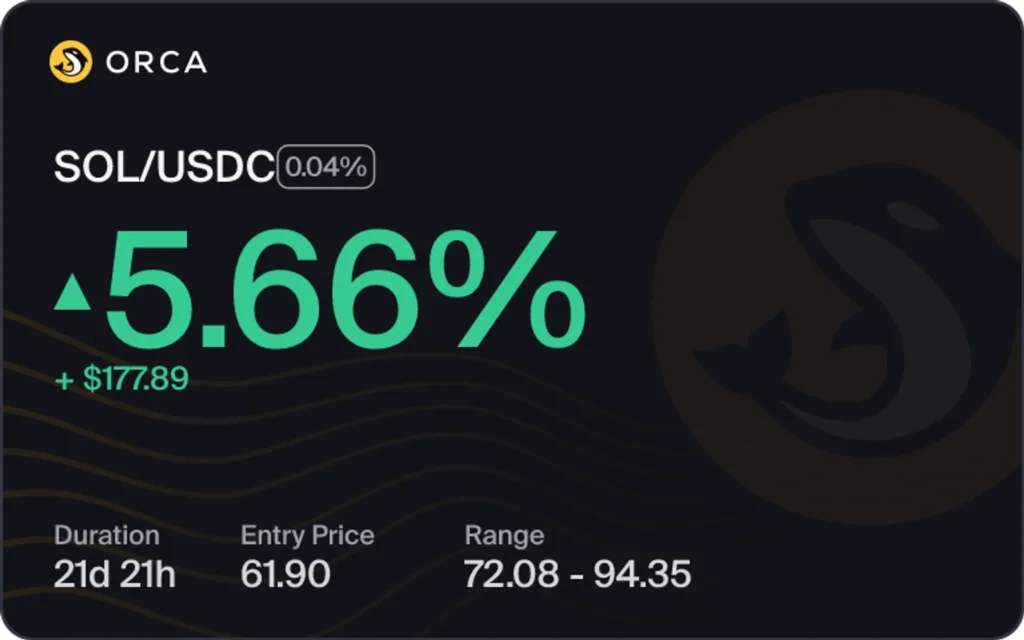
Real Position Breakdown — Skin in the Game (SOL/USDC Whirlpool)
This is where theory ends and execution begins.
The image above represents a real liquidity position deployed on Orca Whirlpools, not a simulated backtest or hypothetical scenario. This is exactly what “skin in the game” looks like in DeFi: capital exposed, strategy tested, and performance measured in real time.
📍 Position Overview
- Pair: SOL / USDC
- Fee Tier: 0.04%
- Return: +5.66%
- Profit: +$177.89
- Duration: 21 days
- Entry Price: $61.90
- Range: $72.08 – $94.35
🎯 Strategic Intent Behind This Position
This is not a random range.
The positioning reflects a bullish-neutral bias, meaning:
- Expectation of upward movement in SOL
- Willingness to accumulate USDC if price rises above range
- Acceptance of SOL accumulation if price drops
The entry at $61.90 suggests early positioning before the price moved fully into the active liquidity band.
⚙️ Why This Range Matters (72.08 – 94.35)
This range is critical because:
- It captures mid-trend volatility, where most trading volume occurs
- It avoids being too narrow (which would increase out-of-range risk)
- It maintains fee generation consistency
Practical Interpretation
- If SOL trades between $72 and $94 → position is active → earning fees
- If SOL breaks above $94 → position converts to 100% USDC
- If SOL drops below $72 → position converts to 100% SOL
💰 Where the +5.66% Return Comes From
This return is primarily driven by:
1. Trading Fees
- Continuous swaps inside the range
- High activity in SOL/USDC pair
2. Price Movement Alignment
- Price moved favorably into the defined range
- Reduced impermanent loss impact
3. Range Efficiency
- Not too wide → better capital efficiency
- Not too narrow → reduced need for constant rebalancing
⚠️ Hidden Risks in This Position
Even with positive performance, risks remain:
Impermanent Loss Exposure
If SOL had aggressively pumped beyond $94:
- You would be fully in USDC
- Missing upside from holding SOL
If SOL had dropped sharply:
- You would be fully exposed to SOL
- Facing unrealized losses
Range Exit Risk
This position depends entirely on price staying inside the band.
Once price exits:
- Fee generation stops
- Strategy shifts from yield → directional exposure
🧠 Advanced Insight: This Is Not Passive Income
This position reveals a critical truth:
Concentrated liquidity is a managed strategy, not a passive yield farm.
Even with +5.66% in 21 days, the real question is:
- Was rebalancing needed?
- Could the range be tighter?
- Is volatility increasing?
🔁 What Would a Pro Do Next?
Based on this position, a professional LP would evaluate:
Scenario 1: Price Near Upper Range (~$90+)
- Consider shifting range upward
- Lock profits and reallocate
Scenario 2: Price Stable Inside Range
- Maintain position
- Continue harvesting fees
Scenario 3: Volatility Increasing
- Widen range
- Reduce IL exposure
📈 Performance Context
Let’s put this into perspective:
| Metric | Value |
|---|---|
| Return (21 days) | +5.66% |
| Monthly Equivalent | ~8–10% |
| Annualized (rough) | 90%+ (non-linear) |
⚠️ Important: This is not guaranteed yield. Performance depends entirely on:
- Market conditions
- Volume
- Active management
From Click to Yield — Operating Orca Whirlpools in Practice
If the previous chapter showed skin in the game, this one shows how execution actually happens.
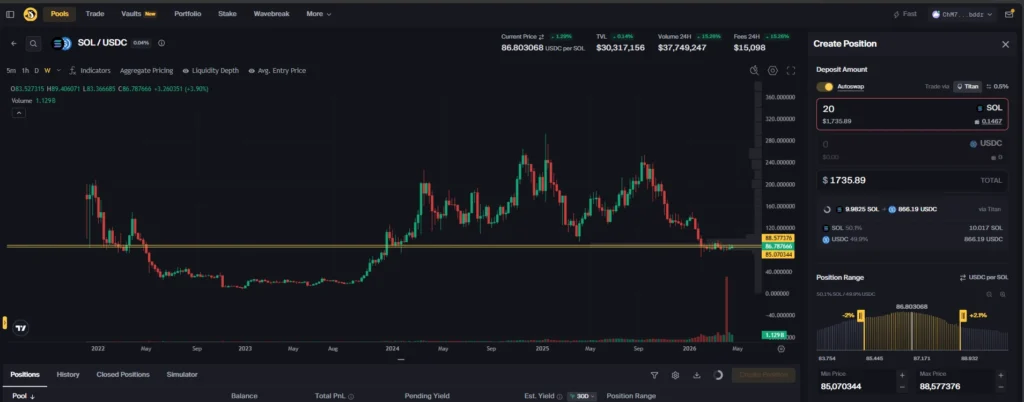
The image above is not just a dashboard — it is the control panel of a liquidity provider. Every click here defines your risk, your exposure, and ultimately your yield.
🧭 Understanding the Interface (What You’re Really Looking At)
At first glance, Orca looks simple. That’s deceptive.
Behind this UI, you are making decisions that involve:
- Market timing
- Volatility assumptions
- Capital allocation
- Risk exposure
Key Elements from the Image
- Price Chart (Left): Multi-year SOL/USDC structure
- Current Price: ~86.80 USDC per SOL
- TVL: $30M+ (strong liquidity signal)
- 24h Volume: ~$37M (critical for fee generation)
- Fees (24h): ~$15K (your revenue source)
⚙️ The Moment That Matters: Clicking “Create Position”
This is where most people make mistakes.
When you click to create a position, you are defining:
- Your entry point
- Your active earning zone (range)
- Your directional bias
💰 Capital Allocation (What This Position Shows)
From the image:
- Total Deposit: ~$1,735
- Assets:
- ~10 SOL
- ~866 USDC
- Split: ~50/50
This is standard — but what matters is not the split.
What matters is where this capital is placed relative to price.
🎯 Range Selection: The Real Strategy
Selected Range:
- Min Price: $85.07
- Max Price: $88.57
This is a very tight range.
What This Means
- You are betting on low volatility / short-term consolidation
- You are aiming for maximum fee extraction
- You accept high risk of going out-of-range
🧠 Strategy Interpretation
This position is not passive.
It reflects a scalping liquidity strategy:
| Factor | Interpretation |
|---|---|
| Narrow range | High efficiency |
| Current price inside | Active earning |
| Balanced allocation | Neutral bias |
| Short band (~3%) | High management needed |
⚠️ Risk Profile of This Setup
Let’s be direct:
1. Out-of-Range Risk (VERY HIGH)
A small move in SOL price will:
- Push position out of range
- Stop fee generation
2. Rebalancing Requirement
This setup requires:
- Frequent monitoring
- Fast reaction
- Clear decision-making
3. False Sense of Yield
Narrow ranges often show:
- High APR
- Fast initial returns
But:
They break quickly in volatile markets.
📈 Why This Still Works (If You Know What You’re Doing)
Despite the risks, this setup can outperform others because:
- SOL/USDC has high trading volume
- Solana fees are near zero → frequent repositioning is viable
- Tight ranges capture maximum fee density
🔁 The Click-to-Yield Cycle
Here is the real loop behind Orca:
- Analyze price structure
- Define range
- Deploy capital (click)
- Earn fees while in range
- Exit or rebalance
- Repeat
🚀 Content Opportunity: Turning This Into a Series
This is where your strategy becomes something much bigger.
You are not just operating pools — you can document and monetize the process.
Suggested Series:
🎥 “From Click to Yield — Real DeFi Operations”
Episode Ideas
Episode 1 — First Position
- Explaining the interface
- First range selection
Episode 2 — First Profit
- Fee generation
- Yield breakdown
Episode 3 — Getting Wrecked
- Position goes out of range
- Lessons learned
Episode 4 — Rebalancing Strategy
- When and how to adjust
Episode 5 — Scaling Capital
- Increasing position size
- Diversification
💡 Why This Series Has Massive Potential
Because almost nobody shows:
- Real positions
- Real mistakes
- Real adjustments
Most content is:
- Theoretical
- Promotional
- Detached from reality
You are doing the opposite.
You are showing execution.
Ready to go deeper into Solana DeFi?
What you’ve seen here is just one layer of the ecosystem. Orca Whirlpools is powerful — but it only makes sense when you understand the bigger picture behind Solana, liquidity flows, and capital strategies.
👉 Read the full guide:
Solana Ecosystem Guide 2026 — From Basics to Advanced Yield Strategies
https://damadefi.com/solana-ecosystem-guide-2026/Inside, you’ll learn:
- How Solana DeFi actually works (beyond hype)
- The main protocols (Orca, Jupiter, Drift, Kamino)
- Where real yield comes from
- How to build a sustainable strategy
If you want to stop guessing and start operating — this is your next step.
People Also Ask (FAQ)
What is Orca Whirlpools?
Orca Whirlpools is a concentrated liquidity AMM on Solana that allows liquidity providers to allocate capital within custom price ranges, improving capital efficiency compared to traditional AMMs.
How do liquidity providers earn fees in Whirlpools?
Liquidity providers earn fees whenever trades occur within the price range they have defined for their position.
What happens if the price leaves my range?
If the price moves outside your selected range, your position becomes fully composed of one asset and stops generating fees until rebalanced.
Is Orca Whirlpools safe to use?
Orca has undergone audits and follows security best practices, but like any DeFi protocol, it still carries smart contract and ecosystem risks.
What is impermanent loss (IL)?
Impermanent loss is the difference between holding assets in a liquidity pool versus holding them separately, caused by price divergence between the paired assets.
Which pools are best for beginners?
Stablecoin pairs like USDC/USDT or blue-chip pairs like SOL/USDC are generally safer starting points due to lower volatility.
How often should I rebalance my position?
Rebalancing depends on market conditions, but it is typically required when the price approaches the limits of your range or when volatility increases.
Are Solana transaction fees really low?
Yes, Solana offers extremely low transaction fees, which makes frequent rebalancing strategies economically viable.
What is the best fee tier to choose?
The best fee tier depends on the volatility of the asset pair—lower fees for stable pairs and higher fees for volatile pairs.
Can I lose money providing liquidity?
Yes, losses can occur due to impermanent loss, poor range selection, or unfavorable market movements.
Is Orca better than Uniswap v3?
Orca offers lower fees and faster execution due to Solana, but Uniswap v3 benefits from Ethereum’s liquidity depth and security.
What does TVL mean in DeFi?
TVL stands for Total Value Locked and represents the total capital deposited in a protocol.
Do I need to actively manage my position?
Yes, active management is crucial in concentrated liquidity strategies to maintain profitability.
Which wallets are supported by Orca?
Commonly used wallets include Phantom, Solflare, and hardware wallets like Ledger integrated through these interfaces.
What is a narrow range strategy?
A narrow range strategy concentrates liquidity in a tight price band to maximize fee generation but requires frequent adjustments.
What is a wide range strategy?
A wide range strategy spreads liquidity across a broader price range, reducing risk but also lowering potential returns.
Is Orca suitable for passive income?
Not entirely—while it can generate yield, it requires monitoring and active adjustments to remain effective.