
Providing liquidity in early-stage tokens is not speculation—it is structured risk-taking with capital exposure. We approach Raydium not as observers, but as participants with skin in the game. Every pool we enter, every token we pair, and every dollar deployed is subject to market forces, slippage, and execution risk. This guide is designed to help you operate inside the Raydium ecosystem with clarity, discipline, and a focus on real yield—not narratives. Raydium Ecosystem: How to Provide Liquidity for New SPL Tokens
Understanding Raydium’s Role in the Solana Ecosystem
Raydium is one of the core liquidity layers on Solana, combining:
- AMM (Automated Market Maker) pools
- Central limit order book integration (via OpenBook)
- Launchpad support for new SPL tokens
This hybrid design allows Raydium to provide deeper liquidity and better price execution compared to standalone AMMs.
Why Raydium Matters for New Tokens
New SPL tokens often launch with:
- Low initial liquidity
- High volatility
- Limited price discovery
Raydium becomes the first battleground where:
- Price stabilizes
- Liquidity forms
- Early LPs extract fees
How Liquidity Provision Works on Raydium
Unlike concentrated liquidity models like Orca, Raydium uses a constant product AMM (x*y=k) for most pools.
Core Mechanics
- You deposit two assets (e.g., TOKEN/USDC)
- You receive LP tokens
- You earn fees from swaps
Liquidity Behavior
| Scenario | Outcome |
|---|---|
| High trading volume | High fee generation |
| Price divergence | Impermanent loss increases |
| Low liquidity pool | Higher slippage, higher rewards |
Fee Structure and Yield Potential
Raydium pools vary in fee structure depending on the token and pool type.
Fee Comparison Table
| Pool Type | Fee Range | Typical Use Case | Risk Level |
|---|---|---|---|
| Stable Pairs | 0.01%–0.04% | USDC/USDT | Low |
| Major Tokens | 0.25%–0.30% | SOL/USDC, ETH/USDC | Medium |
| New SPL Tokens | 0.30%–1.00% | Launch pairs | High |
Yield Drivers
- Trading volume
- Token hype cycles
- Liquidity depth
- Entry timing
Risks of Providing Liquidity for New SPL Tokens
Let’s remove the illusion: this is where most LPs lose money.
1. Impermanent Loss (IL)
New tokens are extremely volatile.
| Condition | IL Impact |
|---|---|
| Rapid price pump | You sell too early |
| Sharp price dump | You hold depreciating tokens |
2. Token Risk (Critical)
New SPL tokens may have:
- No audits
- Low credibility
- Insider allocations
3. Rug Pull Risk
Liquidity can be removed or token value can collapse.
4. Liquidity Fragmentation
Multiple pools dilute your share of fees.
TVL, Security, and Protocol Reliability
Total Value Locked (TVL)
Raydium consistently ranks among the top Solana DeFi protocols.
- High TVL = stronger liquidity confidence
- Low TVL pools = higher risk, higher reward
Security Overview
| Factor | Status |
|---|---|
| Smart Contract Audits | ✅ Yes |
| Open Source | ✅ Yes |
| Battle-tested | ✅ Yes |
| New token risk | ⚠️ High |
Step-by-Step: Providing Liquidity for New Tokens
Step 1: Token Validation
Before providing liquidity:
- Check token contract
- Verify team credibility
- Analyze initial liquidity
Step 2: Pair Selection
Most common pairs:
- TOKEN / USDC → safer
- TOKEN / SOL → higher volatility
Step 3: Capital Allocation
Never go all-in.
| Strategy Type | Allocation |
|---|---|
| Conservative | 5–10% |
| Moderate | 10–20% |
| Aggressive | 20%+ |
Step 4: Add Liquidity
- Connect wallet (Phantom, Solflare)
- Select pool
- Deposit tokens
- Confirm transaction
Step 5: Monitor and Exit
You must track:
- Price movement
- Volume
- Liquidity depth
Raydium vs Orca vs Jupiter
Comparative Table
| Feature | Raydium | Orca | Jupiter |
|---|---|---|---|
| Model | AMM + Orderbook | CLMM | Aggregator |
| Best Use Case | New tokens | Efficient LP | Best price routing |
| Risk Level | High | Medium | Low |
| Yield Potential | High | Optimized | None |
Advanced Strategy: Early Liquidity Positioning
This is where alpha lives.
Key Principles
- Enter early, but not blindly
- Monitor whale activity
- Watch liquidity inflows
Tactical Approach
| Strategy | Description |
|---|---|
| Fast Entry | Enter at launch |
| Volume Tracking | Follow trading spikes |
| Exit Discipline | Lock gains early |
Best Practices for Professional LPs
Risk Management
- Diversify across pools
- Avoid unknown tokens without research
- Limit exposure per pool
Operational Discipline
- Track daily PnL
- Monitor liquidity shifts
- Reassess positions frequently
Security Practices
- Use hardware wallets
- Avoid malicious tokens
- Double-check contracts
Conclusion: Is Raydium Worth It for New Tokens?
Yes—but only if you treat it like a high-risk trading strategy, not passive income.
Raydium offers:
- Early access to liquidity opportunities
- High fee potential
- Strong ecosystem integration
But demands:
- Discipline
- Risk control
- Fast execution
The edge is not in finding tokens—it’s in managing liquidity better than others.
Intuitive Layout — From Click to Execution on Raydium
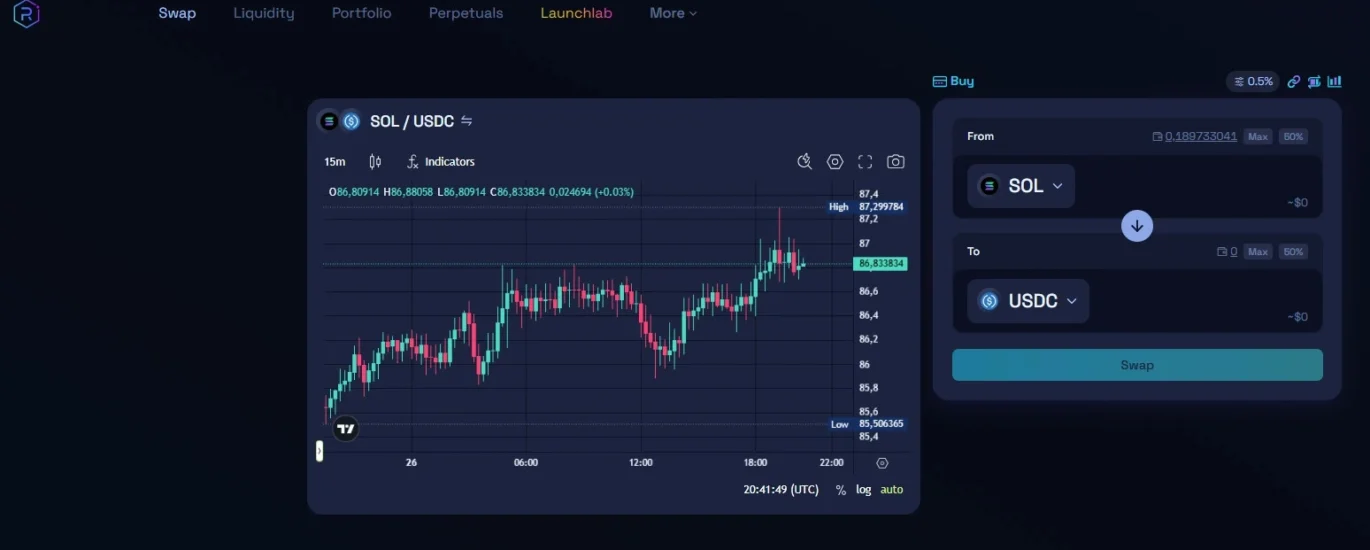
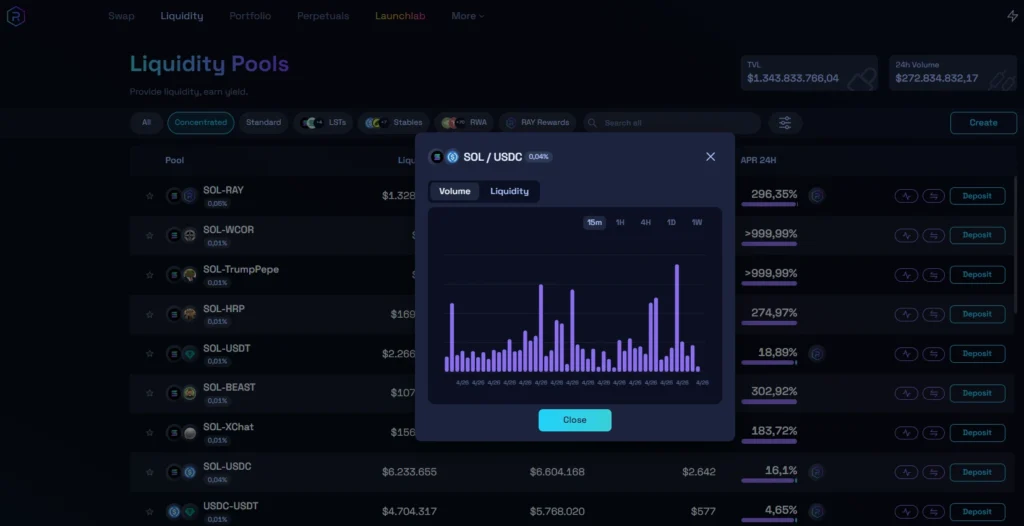
The image above shows something that most beginners underestimate: interface design is part of your edge.
Raydium’s layout is not just visually clean — it is operationally efficient. And in DeFi, efficiency means speed. Speed means better execution. And better execution directly impacts your yield.
🧭 First Impression: Structured for Action
At the top, you immediately see:
- Liquidity Pools dashboard
- Filters like Concentrated, Standard, Stables, RWA
- TVL and 24h Volume metrics
This is not случайное (random) organization.
It is designed to answer one question quickly:
“Where is the money flowing right now?”
⚙️ Click-to-Click Flow (Where Decisions Happen)
Raydium follows a very simple but powerful logic:
Step 1 — Scan Pools
You scroll through available pairs like:
- SOL-RAY
- SOL-USDC
- SOL-TrumpPepe (high risk)
At this point, you’re not clicking randomly. You are scanning for:
- Liquidity depth
- APR signals
- Token credibility
Step 2 — Click the Pool
Once you click a pair (like SOL/USDC in the image), a panel opens showing:
- Volume chart (short timeframe)
- Liquidity behavior
- Activity spikes
This is critical.
Before deploying capital, you are reading market activity in real time.
Step 3 — Interpret the Data
That small chart in the center is more powerful than it looks.
It tells you:
- Is volume consistent?
- Are there spikes (whale activity)?
- Is this pool alive or dead?
🧠 Why This Layout Works
Raydium removes friction between:
- Discovery → Analysis → Execution
Everything happens in 2–3 clicks.
That matters because:
- DeFi opportunities are time-sensitive
- Early liquidity = higher rewards
- Slow decisions = missed yield
People Also Ask (FAQ)
- What is Raydium in the Solana ecosystem?
Raydium is a decentralized exchange (DEX) on Solana that combines automated market maker (AMM) pools with order book liquidity, enabling efficient trading and liquidity provision. - How does liquidity provision work on Raydium?
Users deposit two tokens into a pool and receive LP tokens, which represent their share and earn fees from trading activity. - What are SPL tokens?
SPL tokens are the standard tokens built on the Solana blockchain, similar to ERC-20 tokens on Ethereum. - Is providing liquidity for new tokens profitable?
It can be highly profitable due to high fees and volatility, but it also carries significant risk. - What is impermanent loss (IL)?
Impermanent loss occurs when the price of assets in a pool diverges, causing a loss compared to simply holding the assets. - Why are new SPL tokens riskier?
They often lack audits, have low liquidity, and are highly volatile, increasing the risk of loss or scams. - What is the safest pair for new token liquidity?
TOKEN/USDC is generally safer than TOKEN/SOL because it reduces exposure to dual volatility. - How are fees generated in Raydium pools?
Fees are generated from swaps and distributed proportionally to liquidity providers based on their share. - What is TVL and why does it matter?
TVL (Total Value Locked) indicates how much capital is in a protocol, reflecting its liquidity strength and trust level. - Can I lose money providing liquidity?
Yes, due to impermanent loss, poor timing, or token price collapse. - What is a rug pull in DeFi?
A rug pull occurs when developers remove liquidity or abandon a project, causing the token price to crash. - Do I need to monitor my liquidity position?
Yes, especially with new tokens, as market conditions can change rapidly. - Which wallets are compatible with Raydium?
Popular wallets include Phantom and Solflare, often used with hardware wallets for added security. - What is the difference between Raydium and Orca?
Raydium uses a traditional AMM model with order book integration, while Orca focuses on concentrated liquidity. - What is the best strategy for new token pools?
A cautious approach with small allocations, early entry, and fast exit is typically more effective. - How do I choose a reliable token?
Analyze the team, contract, liquidity, community engagement, and whether the project has audits. - What is slippage in liquidity pools?
Slippage is the difference between expected and executed trade price due to low liquidity or large trades. - Is Raydium audited and secure?
Yes, Raydium has undergone audits, but risks still exist, especially when interacting with new tokens. - Can I withdraw my liquidity at any time?
Yes, liquidity can be removed at any time, converting LP tokens back into the underlying assets. - Is liquidity provision passive income?
No, especially with new tokens—it requires active management, monitoring, and strategy adjustments.